
Lightning in the Veins
The Weather of a Man
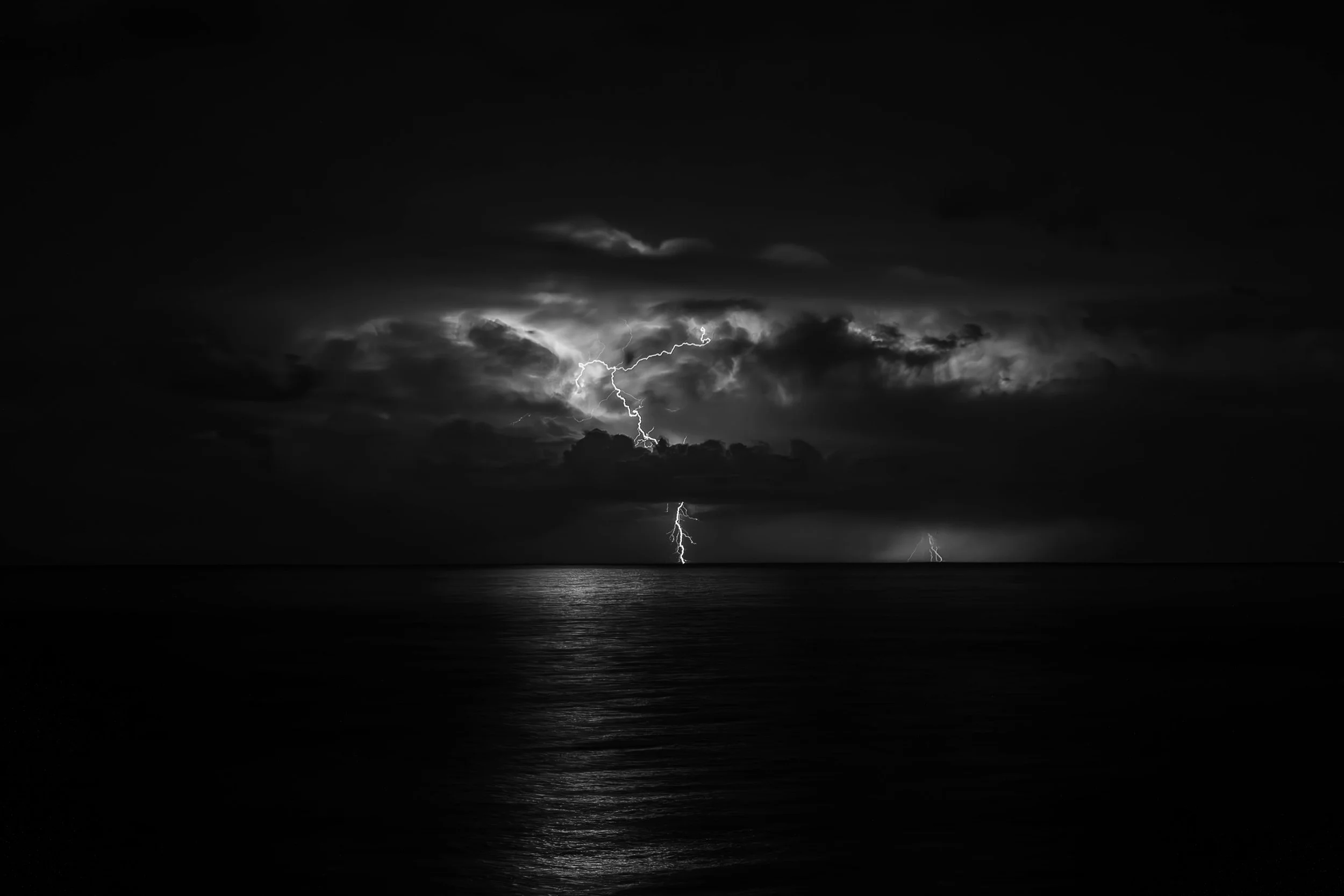
He rises from torn pages and thunder,
a silhouette stitched from rumor,
drifting through centuries like smoke.
Not a saint,
not a villain,
but a storm wearing the shape of a man—
his pulse a stanza,
his shadow a wound,
his life an unending spark on the horizon.
Enter here,
where the poet refuses to stay dead
and the myth refuses to stay still.
Logline.
The notorious life of superstar Lord Byron, a restless poet whose determination to free and find himself in a changing world finds him freeing those oppressed by the same forces. ✺
THE UNQUIET GUEST
There is a presence at the threshold.
A figure pacing the frame
as if the reel cannot contain him.
He moves in fragments—
ink and saltwater,
ruin and allure,
a heart too loud for the century that held it.
This film is an invitation to witness the fire
that history tried to name,
but never extinguished.
Synopsis.
Many things to many people, but never the same to everyone, here is Byron fleeing how others misperceive him, defying definition while fighting for and against the disgraced love of men tormenting him from within, the rumoured affection not so secret, the buried desire he carries and wars with often, portrayed in his contradictory, conflicting roles.
Freedom becomes oppression. Exiled to world’s edge, living a life of passionate excess as if ever conscious of its approaching end, sparkling wit ignites an explosion of prolific literary output expressive of sentiments more relevant now than when he first penned them.
Raging, along the way in his whirlwind wanderings committing to page what translates best on the screen, here is Byron’s flawed journey inward turned universal struggle, visceral, visionary, and visual.
Ranging from celebrated overnight success, society darling, indulgent libertine, literary heavyweight, global cultural phenomenon, innovator of language, originator of new phrases, beguiling lyricist, pursuer of extreme experiences, tortured self-destructive artist, disgraced provocateur, exiled aristocrat, predatory decadent world-traveler, rebel liberator, legendary seducer, outspoken advocate, sex symbol, Satanic influencer, risk-addicted adventurer, lucrative self-marketer, iconic image-maker, glamorous addict, impoverished elite, stalked idol, misanthropic philanthropist, anti-establishment noble, et cetera.
Enriched with glimpses of his outrageousness and its dangerous impact on those around him during such transformations, the film is not a documentary, but a gritty, unconventional depiction of a larger-than-life historical figure.
Wet with sex, sweat, tears, and ink, blood may well be the perspiration of genius as the tone and content of the synched music matches that of the project, promising a decadent experience filtered through an unsettling amount of distortion.
The prototypical proponent of living fast and dying young, Byron’s reason to be was to become someone whose own legend he could not only believe in, but live up to without apology or regret, knowing self-knowledge is one’s greatest asset no matter how easy to sell and difficult to accept. ✺
Alternate Synopsis.
Born for opposition, destined to infamy, and built for tragedy, an only child raised in abject poverty by a single mother in rented rooms above a perfume shop after his profligate father ran off with her inheritance then killed himself abroad before he even started school, Byron walked with a limp and a chip on his shoulder, toeing the proverbial line between dignity and disaster, speaking with a mixed Scotch-English accent, inheriting unexpectedly at aged 10, from a notorious great-uncle, the barony that made him a lord. With it came the crumbling ruins of his ancestral mansion, a pile of multi-generational debts, and an abundance of privilege, nonetheless.
His was an age at the edge of collapse, when revolutions and romance hand-in-hand abandoned reason for feeling, leading tradition to its death. Killing fields dotted countrysides, boundaries realigned, kings lost their heads, common individuals made themselves immortal examples of progress, industrialism created a middle class, a mass market, an entertainment industry, celebrity, and the weekend which, until then, didn’t even yet exist as we know it ever since, while machinery replaced technique, challenging craftsmanship, engendering ubiquity, technology at once weakening and empowering meanings and ways of being.
As well, increasing communication. Printing presses, publishing houses, and an international postal network inked the blueprint for our Internet, linking continents and blurring cultures. Letters anticipated blogging and were shared like social media posts, traded among friends, carefully kept, copied, and readable today. Every private conversation between correspondents penned to be an open secret.
Byron’s writings were available in 45 languages in his own lifetime, in approved and pirated editions, and read on every continent through colonial expansion. He had fan mail, stalkers, merchandise, sat for more portraits than royalty yielding globally recognized images reproduced in massive quantity, toured, and bore for the world his lucrative brand of tortured soul that came to bear his name as an adjective: Byronic. ✺
Summary.
An original biopic of Lord Byron, the highly controversial and complicated poet, the self-professed first celebrity, and very much the original antiheroic rock star.
A gritty, unapologetic drama, dark in tone and sinister in mood, exploring Byron’s notorious personality, unrivaled genius, paradoxical contrasts, contradictions, highs, lows, pendulum swings between ego peaks, and reversals of fortune, as well as his complex relationships, at once with his own suffocating global fame, ravenous fan base, and intimacies with men and women.
No prior knowledge of the life, work, or legacy of Byron is necessary to appreciate the cinematic experience and true story. ✺

Thematic Overview.
In Lightning in the Veins, we delve into the dark erotic and emotional tension of Byron’s hidden gay relationships, cast beneath the suffocating weight of his fame. This film explores the undercurrents of secrecy, exposing the transgressive lyricism of a man torn between forbidden love and the myth that would consume him. ✺
Source: Original theatrical release poster for The Bad Lord Byron (dir. David MacDonald, 1949), written by Paul Holt, Laurence Kitchin, Peter Quennell, Anthony Thorne, and Terence Young, produced by Sydney Box Productions, distributed by General Film Distributors Limited and International Releasing Organisation, from the production and marketing materials in the J. Arthur Rank Organisation Collection, ITV Archive, Leeds; Copyright © 1949, 2025 ITV Studios Global Distribution Limited, ITV Studios, a subsidiary of ITV plc.
THEATRICAL
“I am become a celebrated victim of my own fame—a veritable Celebrity.”
Source: Original broadcast release poster for Byron (dir. Julian Farino, 2003), written by Nick Dear, produced by BBC Drama Group, distributed by British Broadcasting Corporation (BBC) and BBC Worldwide, from the production and marketing materials in the BBC Television Archive, BBC Archive, Perivale, London; Copyright © 2003 BBC Studios Distribution Limited, British Broadcasting Corporation (BBC), Department for Culture, Media & Sport, His Majesty's Government of the United Kingdom of Great Britain and Northern Ireland
TELEVISION
Two centuries of fascination. Only twice has Lord Byron’s life been fully dramatized. Now, after more than 75 years, his passions, scandals, and legend erupt onto the screen. The first feature-length portrayal of Byron since 1949. ✺
For over two centuries, Lord Byron has inspired scandal, myth, and fascination, yet only twice has his life taken centre stage on screen: the 1949 theatrical The Bad Lord Byron and the 2003 BBC television drama Byron. Now, after more than 75 years, his story returns in all its complexity—the passions, controversies, and intimate relationships that made him history’s most enigmatic poet. ✺
The first feature-length portrayal of Byron since 1949.
Before the images assemble,
before the story chooses its shape,
there is only the poet—
raw, restless, radiant with contradiction.
We meet him in the half-light of becoming,
where biography melts into fever,
where the past exhales
and the present listens.
In this darkroom,
Lord Byron develops not as legend,
but as living apparition.
THE POET IN THE DARKROOM
Excerpt (First Draft).
FADE IN:
EXT. GRAND CANAL, VENICE, MAY 1819 – NIGHT
An icon in silhouette dissolving into focus takes form impossible to ignore: LORD BYRON (31 here), pale, brooding, athletic, big fish-minded small-fry upstart upstream swimmer of changing currents astride this new world and the old.
Weathered contrarian. Firebrand wielder of words. Privileged champion of every underdog. Wounded, brunet pursuer and seducer of anything with a pulse. A spectre or a caricature in ill-fitting, well-worn black clothing. His story is one more enemies than friends have told.
As adept with a quill as with a pistol, his lips or his fists, this is he whose calculated scowl only complements his vanity.
Accompanied as it is with enough wealth, and wealth of literary talent, to balance out his moral bankruptcy’s many controversies borne of as many drawn-out swinging moods. Most of which are self-promoting stories of his own design. Legendary wreckage to leave behind. Good time kind-of-guy.
He is a man who, apart from the dark art-form of his perfect tantrums, has written many lives inspired by the one he has decided to live for his ravenous public. A spectre or a caricature or a character. Antihero of his own story, villain of his own myth.
Transformed in every way by worldwide fame at an early age, except for childhood trauma’s stinging memories and his deformity’s crippling embarassment, he needs always to prove himself. In particular, now.
He emerges from the ebbing, murky waters of the moonlit Grand Canal, its obsidian ribbon a silent witness over which glides undulating slivers of reflected torch-light splintering into frenetic ripples as his heavy clothing clings to his body, saturated head-to-toe.
From windows above lining the crumbling faces of ancient grey palazzos, billowing curtains tease glimpses of glowing warmth from the apartments of lovers busying themselves within. Shadow drapes the streetscape in high contrast, mocking discretion. Shadows are dancing against stoic stone as his chiseled face crumbles into disgust.
He climbs over the edge of the pavement bordering the dark pool and, like a poet’s pen from an inkwell, lifts the hulk of himself, as though he were the diluted idea of his ideal self, shivering onto the cobblestones and unfolds his trembling limbs from a crouch into a determined hobble, dignified despite wearing the sopping mess of his obvious misadventure.
Though he has fallen or jumped in, he limps on his right foot, regardless. Ever self-conscious, looking in either direction at the deserted corridor of claustrophobic street down which his voice echoes.
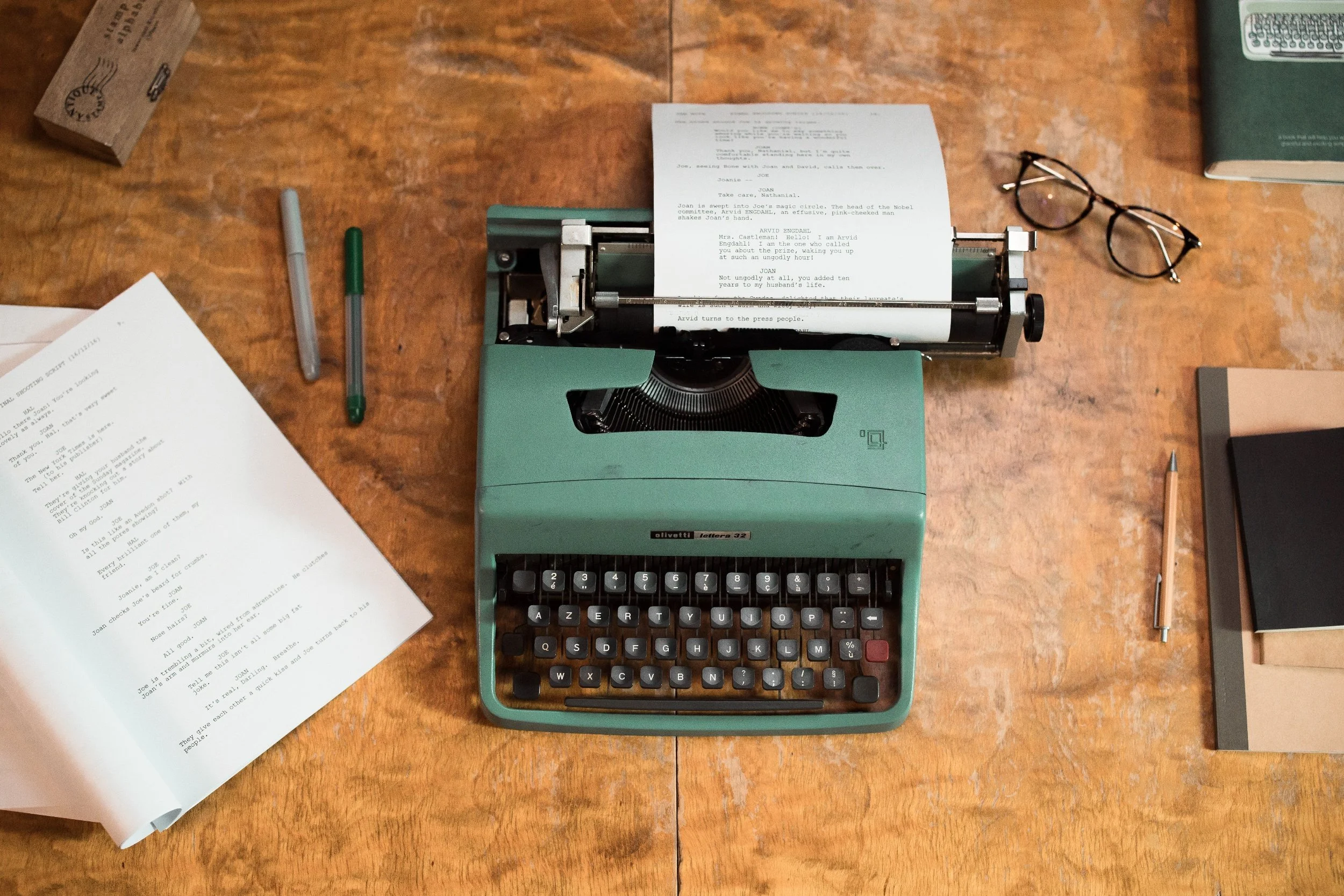

Excerpt (Final Draft).
Status Indicator.
IN PRE-PRODUCTION
Taglines.
Chaos fills the void—cut a path or perish!
Chaos fills the void.
Cut a path or perish!
He may be a libertine but he’s a liberator, too.
Electricity meets enigma where shadows ignite.
Electricity meets enigma.
Where shadows ignite.
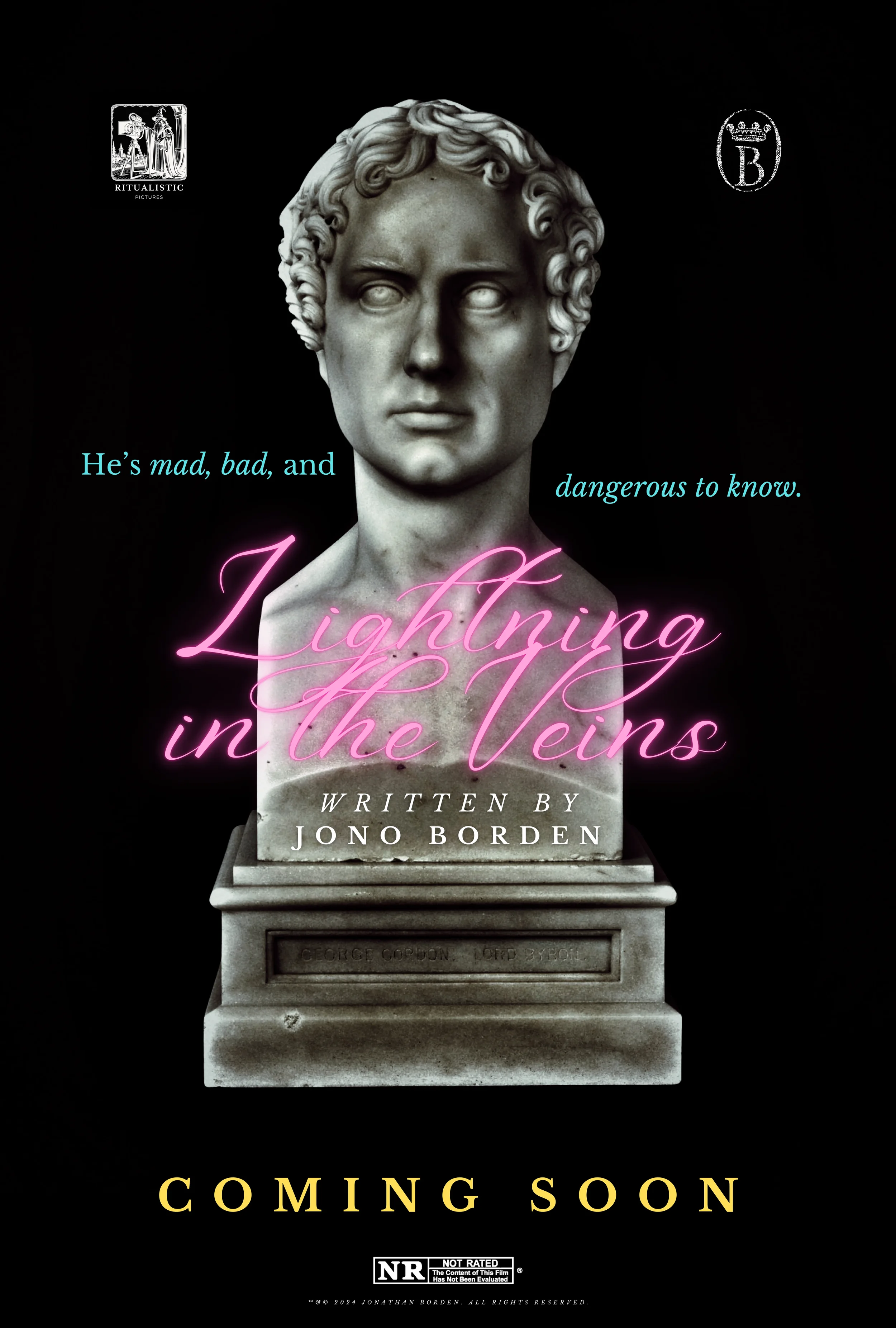
He’s mad, bad, and dangerous to know.
A celebrated victim of his own fame.
Truth is always strange; stranger than fiction.
Pleasure’s a sin, and sometimes sin’s a pleasure.
Among them, but not of them.
Development Resources.
Alternate Title.
Cinematic Reliquary.
“The main task for any biographer intrepid enough to take on the subject of George Gordon, the sixth Lord Byron, is to give equal time to both versions of the man: Byron as he really was, and Byron as a symbol—what he meant to the world, what he stood for and to some extent still stands for today. These two Byrons are so very different that it is sometimes hard to make them coalesce into a single figure.”
“A true story rooted in a distant yet universal reality, the film is an original screenplay, not an adaptation, and not based on any particular published biography, but the product of its author’s research and imagination, with drama and dialogue drawn from and inspired by Byron’s timeless works, lively correspondence, and incisive journals, giving vision and voice to a monolithic man at once at odds with society, his own myth, and his place in history.”
Watch Byron love boldly, scandalize ruthlessly, and reveal passions, romances, and forbidden desires long hidden. ✺
Biography ✺ Romance ✺ Drama

The Right Honourable George Gordon Byron, 6th Baron Byron of Rochdale, FRS, MA (1788–1824)
PRESENTING BYRON
Through the Artist’s Eye
These portraits are more than artistic interpretations; they are authentic likenesses of Lord Byron, each created from sittings where the poet himself posed and personally approved. Captured during his lifetime, these images offer a rare and intimate glimpse into the man behind the legend—an invaluable record of his persona as seen through the eyes of the artists who immortalized him.
✺
Byron’s portraitists often noted his paradox: a man who could laugh and smile in life but would adopt a gloomy, scowling pose for his painted likeness. He knew that the brooding, tortured genius would captivate—and he leaned into the myth. Selling an attitude, influencing generations. Perpetuating the image of him we still live with ever since. Many of those closest to His Lordship claimed none of these pictures even remotely resembled the poet. This gallery encapsulates how he used his public persona as a cultural commodity. A true icon, whether or not you buy into his body of work. Byron’s mythic status transcends his poetry, forever etched in the collective imagination.
“Mad, bad, and dangerous to know.”¹
“I awoke one morning and found myself famous.”²
✺
Notate Bene:
¹Lady Caroline Lamb, describing Lord Byron, writing of her first impression of him the same night they were introduced to one another at a ball, in a diary entry for Tuesday, March 24th, 1812, according to Elizabeth Jenkins’ Lady Caroline Lamb, published at London by Victor Gollancz Ltd in 1932; page 95.
²Lord Byron, in his unpublished memoirs, Memoranda—and not Confessions, composed by the poet at Venice between July 10th and August 26th, 1818 and given by him to his colleague, correspondent, friend, confidant, and official (though by no means first or only) biographer Thomas Moore on October 11th, 1819; a scattered, candid, autobiographical manuscript then of 78 folio sheets (156 oversized pages) covering his life, opinions, adventures, fame, relationships, scandals, and reputation, in his own words, as of that date current through to 1816, with Byron sending scintillating additions to Moore on a regular basis up until his death in 1824. ¶ Considered to be one of the most notorious crimes and greatest losses in literary history when, at the overly-cautious behest of Byron’s longtime publisher, John Murray (fearful of igniting further scandal by their much-anticipated publication), the only copy of the memoirs—Byron’s voluminous manuscript compilation tell-all (then filling two handwritten volumes)—was burned in Murray’s parlour fireplace at 50 Albemarle Street, London on May 17th, 1824, with Moore (the only one to object to this desecration) and others of the poet’s inner circle in attendance, no known copies having ever been made. ¶ Quoted for the first time in “Notices of the Life of Lord Byron[:] A.D. 1812” of Letters and Journals of Lord Byron: with Notices of His Life, by Thomas Moore. In Two Volumes. Vol. I, published at London by John Murray in 1830; page 347. ¶ That Moore had in his possession, and close at hand, Byron’s coveted memoirs (now lost) from which to quote is as close to the primary source for this oft-repeated musing of the poet as any researcher will ever get. Every subsequent use of this phrase can be traced to Moore’s biography, the only authorized story of Byron’s life and—for more than a century after his death—long the standard version of events until recent scholarship unearthed what prior eras’ pretensions to decency sought to purge. The phrase does not come from Byron’s works or letters, since uncensored, but is a quotation as well-known as the poet himself. ¶ For more on dates of composition, destruction, and other details, refer to Norman Page’s A Byron Chronology, published at Houndmills, Basingstoke, Hampshire by Macmillan Press in 1988, pages 56–57, 63–64, 68, and 93; as well, Leslie A. Marchand’s Byron’s Letters and Journals, Volume VI: ‘The flesh is frail,’ 1818–1819, published at Cambridge, Massachusetts by Harvard University Press in 1976, pages 58–59 and 63–64. Autograph letters to John Murray in which Byron mentions penning and finishing the first iteration of his memoirs: Manuscript 43489, folios 243 and 246, at the National Library of Scotland, Edinburgh.
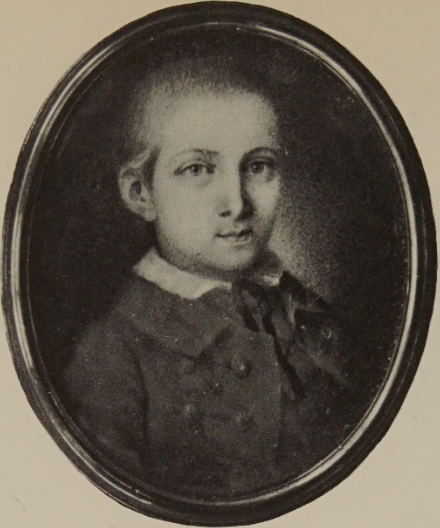
Source: Unknown Artist (floruit 1795), “George Gordon Byron,” 1795, watercolour miniature on ivory, 9 × 6.3 cm (3 35/64 × 2 31/64 in.), Old Speech Room Gallery (OSRG) Arts Society Collection, accession number unknown, Vaughan Library, Harrow School, Harrow on the Hill, Greater London
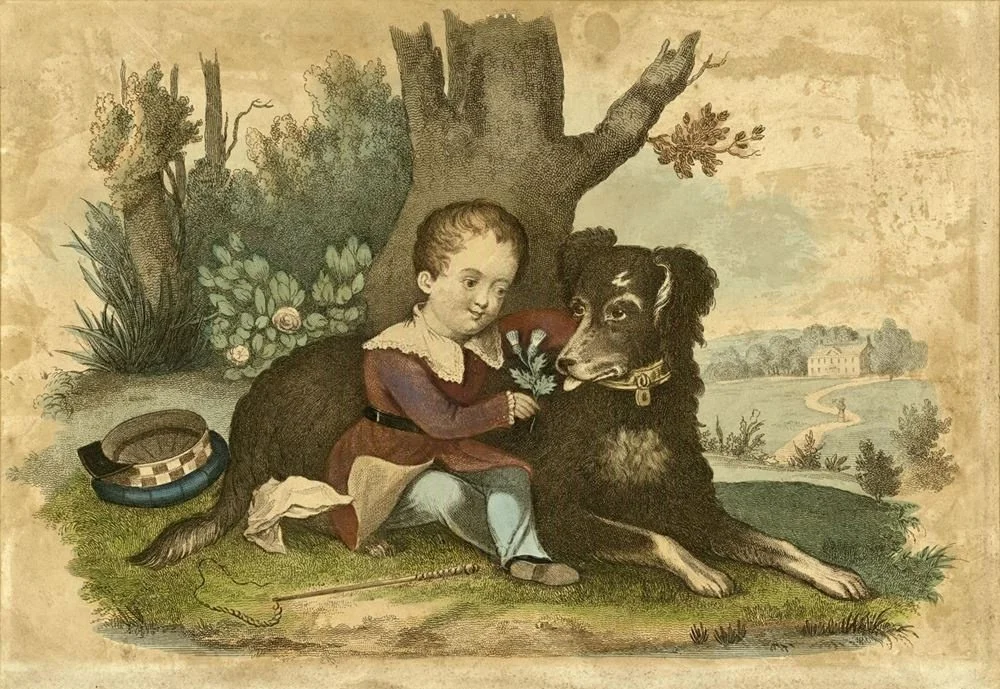
Source: Unknown Artist (floruit 1796), “Infant Byron and Favourite Dog,” 1796, hand-coloured engraving, 37 × 52.8 cm (14 9/16 × 20 51/64 in.), Nottingham Local Studies Library Photograph & Image Collection, accession number NTGM009204, Newstead Abbey, Nottingham City Museums & Galleries, Nottingham City Council, Ravenshead, Nottinghamshire
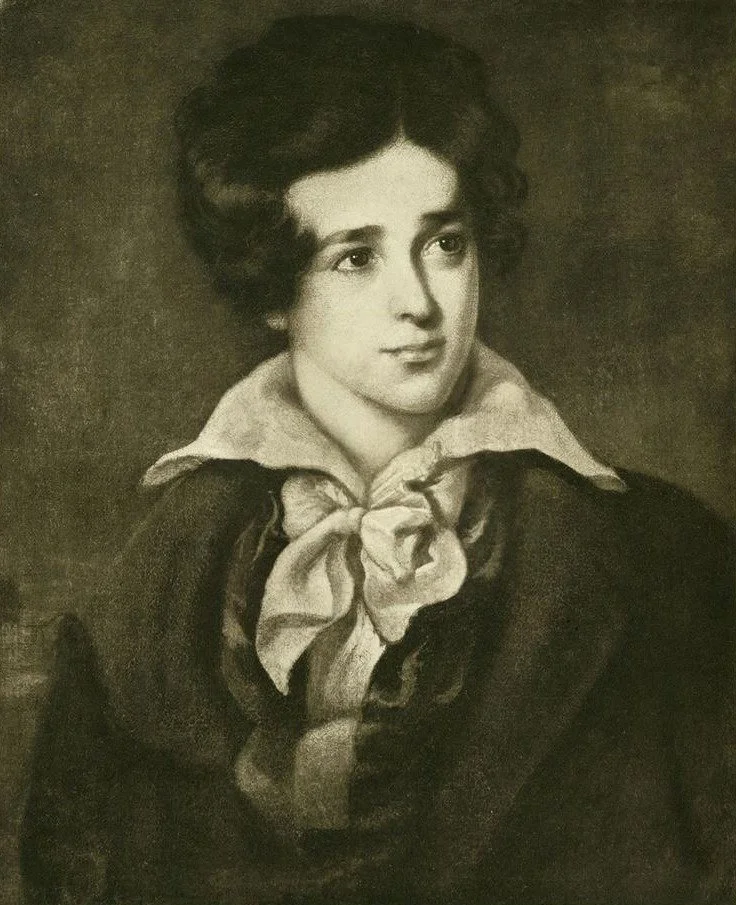
Source: Thomas Lawrence (1769–1830), “George Gordon Noel Byron, 6th Baron, as a Boy,” 1800, mezzotint, 48 × 39 cm (18 29/32 × 15 11/32 in.), Nottingham Local Studies Library Photograph & Image Collection, accession number NTGM009314, Newstead Abbey, Nottingham City Museums & Galleries, Nottingham City Council, Ravenshead, Nottinghamshire
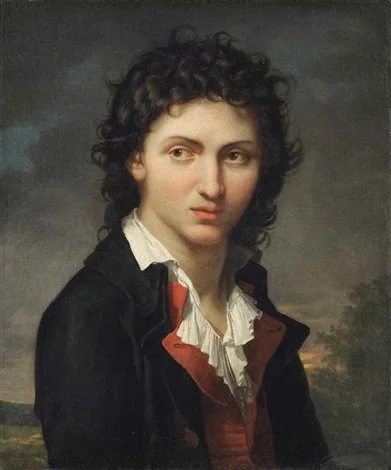
Source: Élisabeth Louise Vigée Le Brun (1755–1842), "Lord Byron," April 1802–May 1805, oil on canvas, 56.5 × 47.6 cm (22 ¼ x 18 ⅞ in.), Auctioned at Christie's London, South Kensington, on 5 December 1969 in an Anonymous Sale [The Property of a Lady of Title], lot number 103, Auctioned at Christie’s London, South Kensington, on 2 November 2016 (Live Auction 12307) in the Old Master and British Paintings Sale, lot number 99, Private Collection
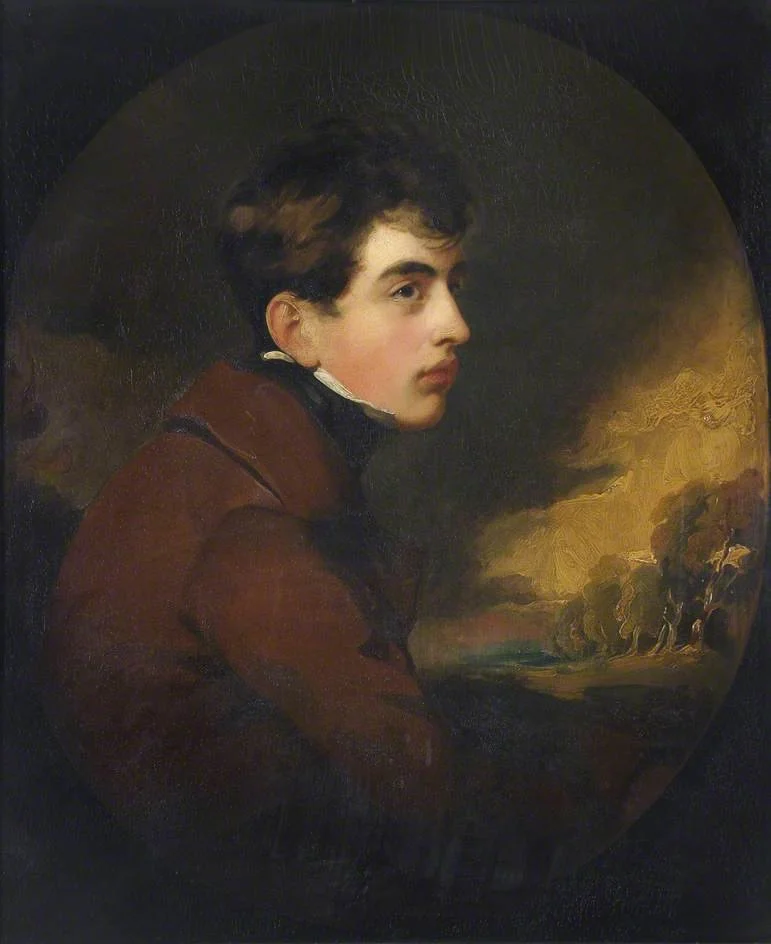
Source: Thomas Lawrence (1769–1830), “George Gordon Noel (1788–1824), Lord Byron, Poet,” circa 1805–1808, oil on canvas, 74 × 61 cm (29 ⅛ × 24 1/64 in.), Gift from A. C. Benson, 1907, accession number TC Oils P 32, Trinity College, University of Cambridge, Cambridge
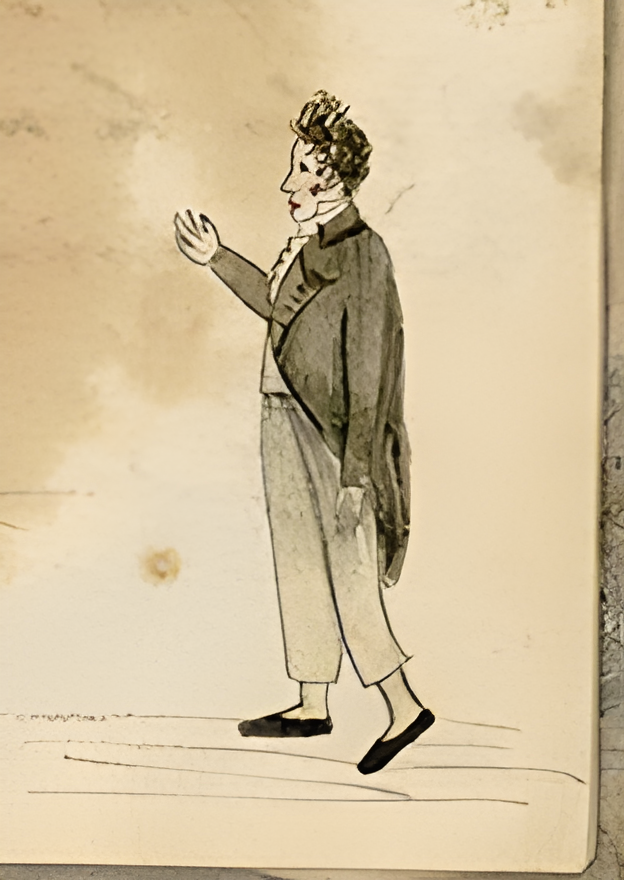
Source: Elizabeth Bridget Pigot (1783–1866), “Byron Visits the House of Reverend Thomas Beecher and Boatswain, Turned Vicar, Says to Byron: ‘Repent Ye Wicked, Resist Temptation’ (Illustration from The Wonderful History of Lord Byron and His Dog),” March 26, 1807, ink and watercolour on paper, 7.5 × 5 cm (2 61/64 × 1 31/32 in.), Purchases, 1961, 1964, 1965, 1966, 1970, 1974, 1977, and Gift, 1970, accession numbers R887, R2209, R2722, and R7837, The Wonderful History of Lord Byron and His Dog, folio 4, Box 6 Folder 8, Series III. Third Party Correspondence and Manuscripts, George Gordon Byron Collection, Harry Ransom Center, The University of Texas at Austin, Austin, Texas
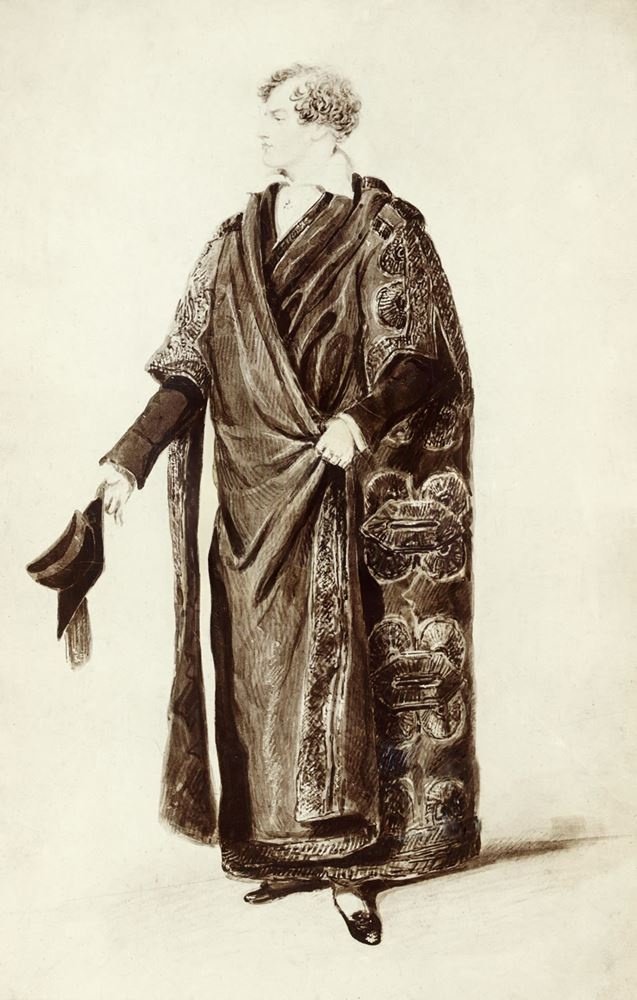
Source: Gilchrist of Cambridge (floruit 1807), “George Gordon Noel Byron, 6th Baron (Byron in a Nobleman’s Academical Robes as an Undergraduate at Cambridge),” 1807, watercolour, 52.9 × 33.7 cm (20 53/64 × 13 17/64 in.), Nottingham Local Studies Library Photograph & Image Collection, accession number NTGM009319, Newstead Abbey, Nottingham City Museums & Galleries, Nottingham City Council, Ravenshead, Nottinghamshire
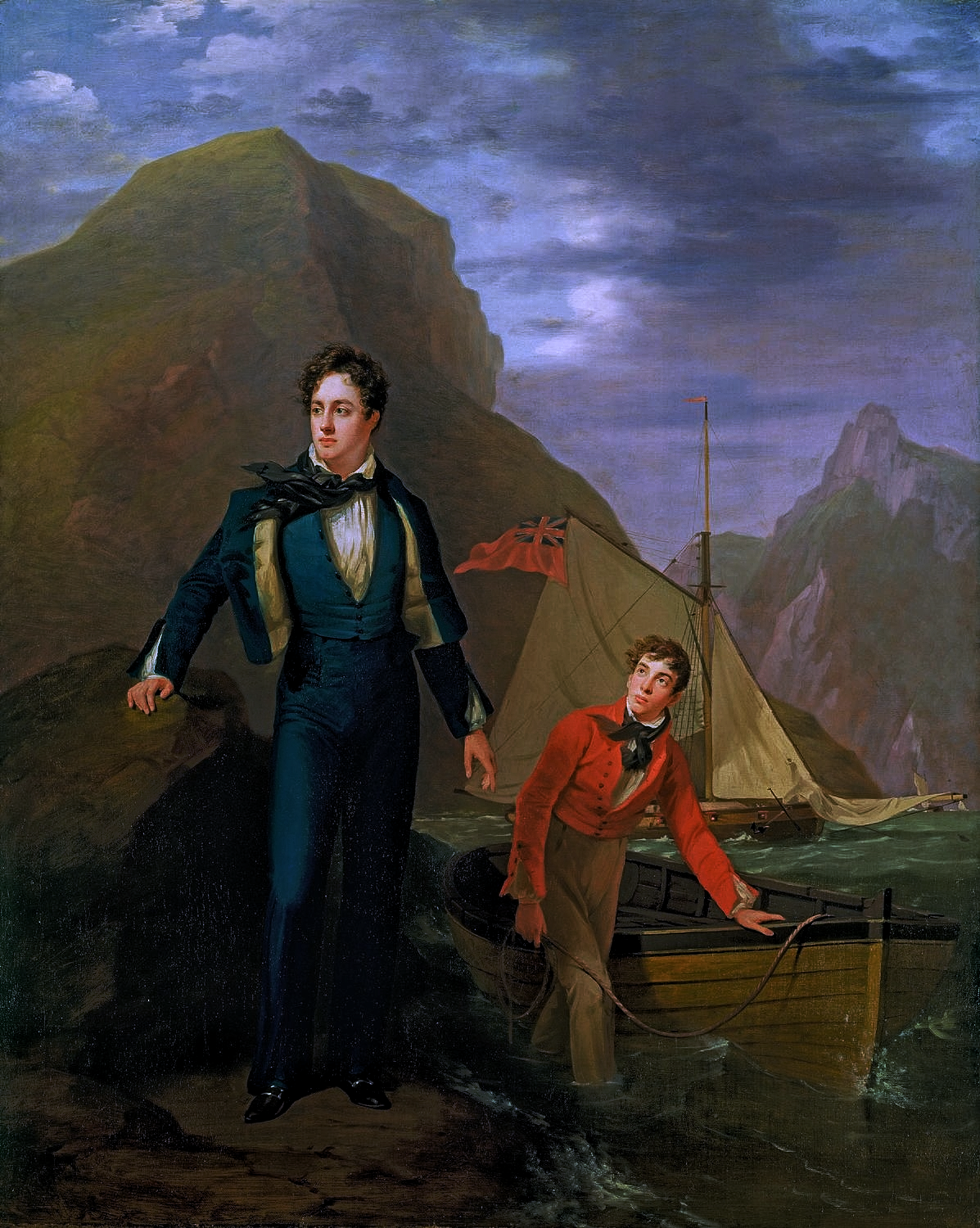
Source: George Sanders (1774–1846), “George Gordon, 6th Lord Byron (1788–1824), called also Lord Byron and His Servant Robert Rushton (1793–1833),” 1807–1808, oil on canvas, 112.5 × 89.4 cm (44 9/32 × 35 3/16 in.), Bequeathed to King George V in 1914 by Charlotte, Lady Dorchester, daughter of Lord Hobhouse, accession number RCIN 402411, Royal Collection Trust, London (on view at The King’s Gallery, Palace of Holyroodhouse, Edinburgh); Copyright © His Majesty King Charles III

Source: Samuel Drummond (1765–1844), “George Gordon Byron in His Graduate Gown (M.A., Trinity College, Cambridge),” 1808, oil on canvas, 63.5 × 53.4cm (25 x 21 1/64 in.), Auctioned at Christie’s London, South Kensington, on 11 November 2004 in an Anonymous Sale, lot number 303, Auctioned at Bonhams London, Knightsbridge on 4 October 2017 in the Capital Style: Two London Collections Sale, lot number 186, Private Collection
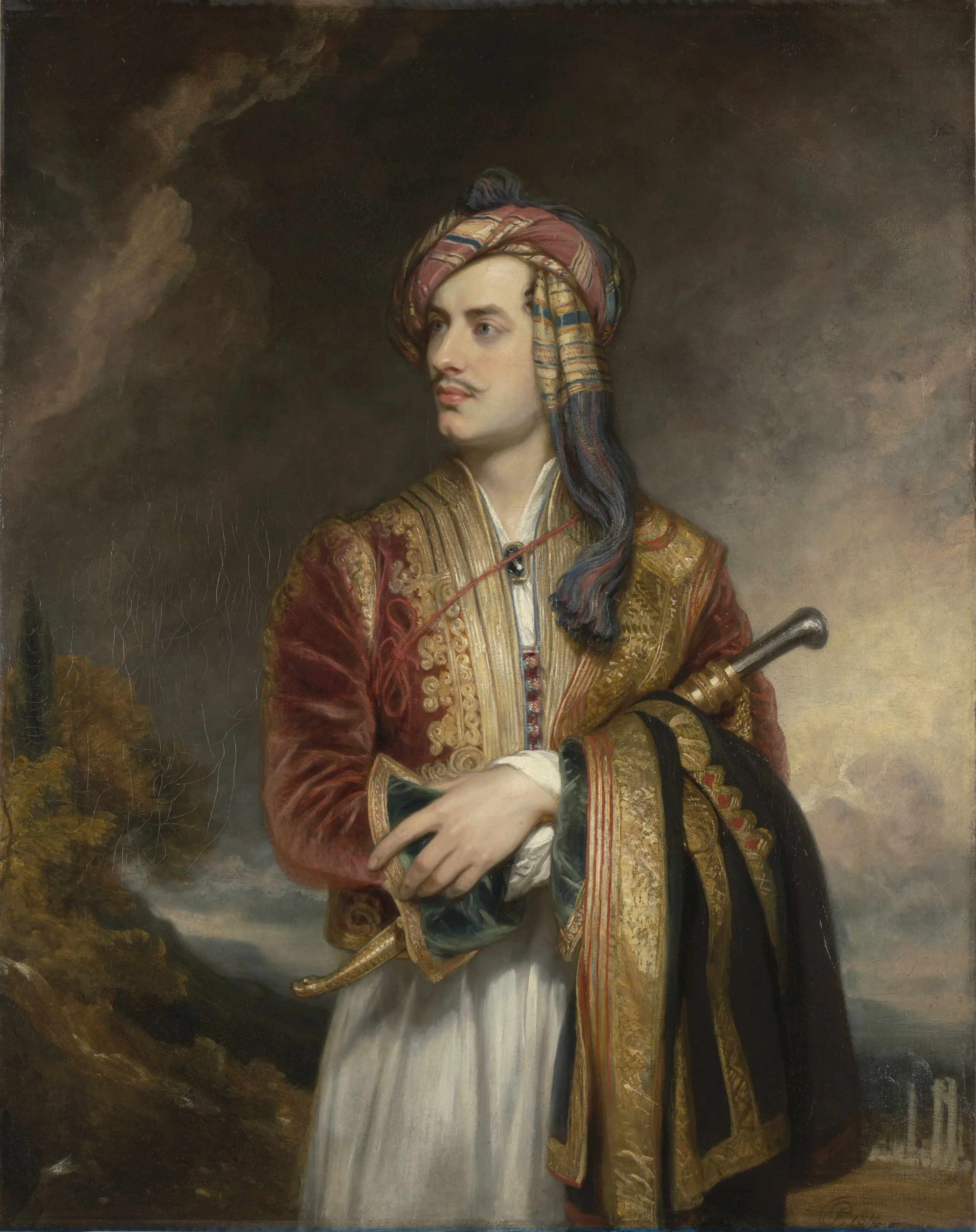
Source: Thomas Phillips (1770–1845), “George Gordon Noel Byron (1788–1824), 6th Baron Byron, Poet, called also Lord Byron in the Dress of an Albanian,” 1813, oil on canvas, 127 × 102 cm (50 × 40 5/32 in.), Purchased from the 4th Earl of Lytton via Leggatt Bros., December 1952, accession number GAC 1976, Government Art Collection, Department for Culture, Media & Sport, His Majesty’s Government of the United Kingdom of Great Britain and Northern Ireland, London (normally on view at the Ambassador’s Residence, British Embassy Athens, currently exhibited at the Benaki Museum, Athens during renovations)
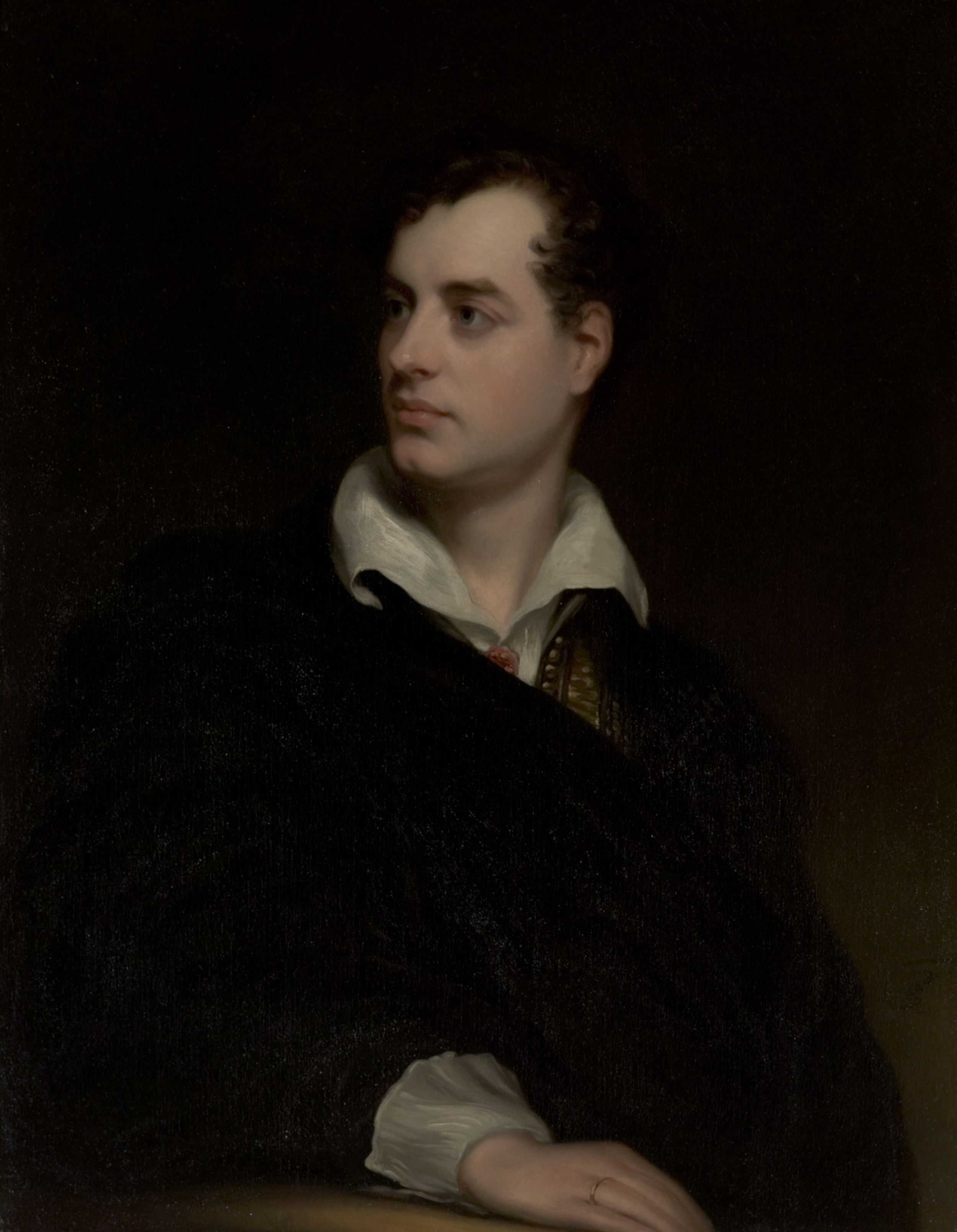
Source: Thomas Phillips (1770–1845), “6th Lord Byron (1788–1824),” 1813, oil on canvas, 91 × 71 cm (35 13/16 × 27 15/16 in.), Gift from Charles Ian Fraser, 1931, accession number NA 532, Newstead Abbey, Nottingham City Museums & Galleries, Nottingham City Council, Ravenshead, Nottinghamshire
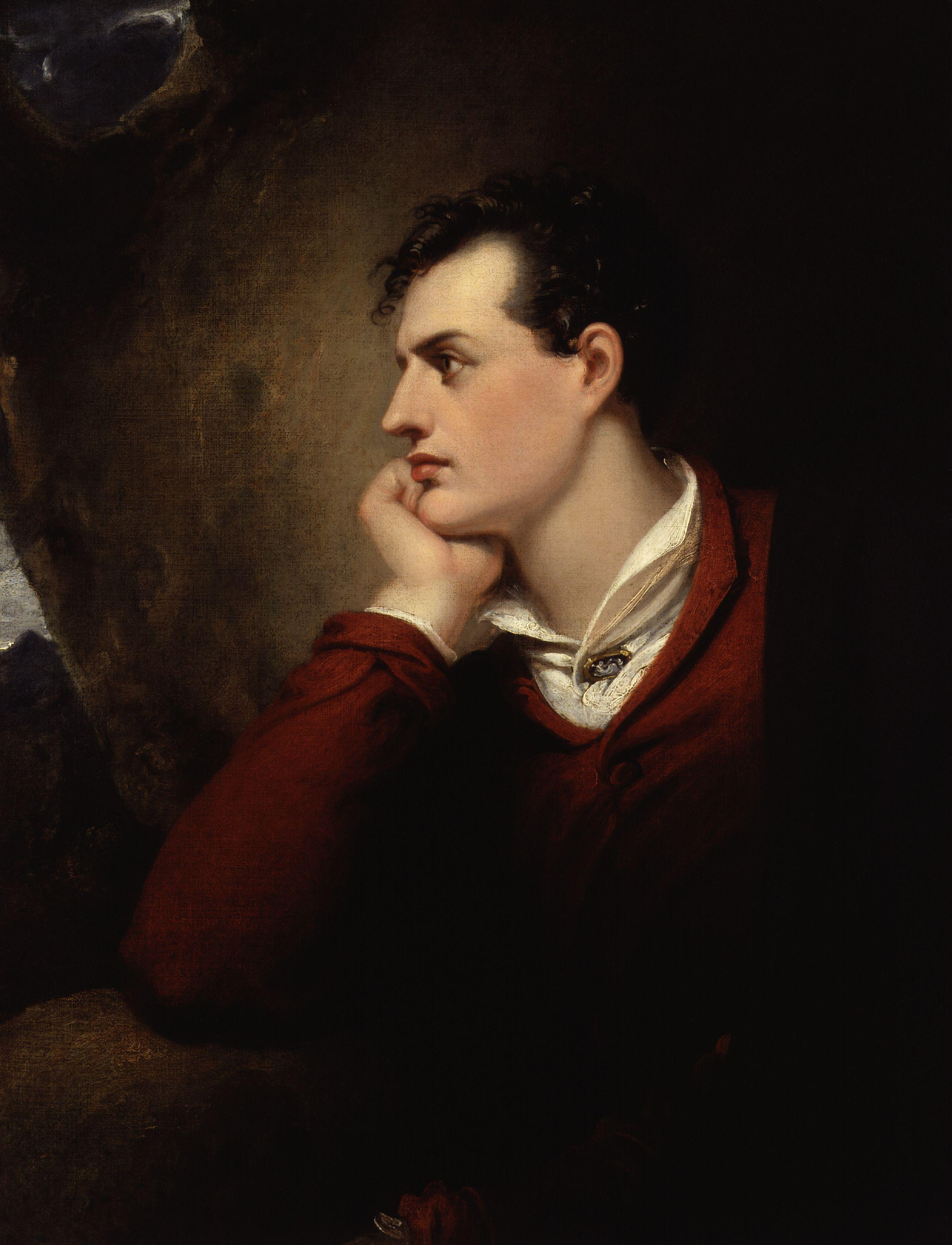
Source: Richard Westall (1765–1836), “Lord Byron,” 1813, oil on canvas, 91.4 × 71.1 cm (36 × 28 in.), Purchased, 1961, Primary Collection, accession number NPG 4243, National Portrait Gallery, London
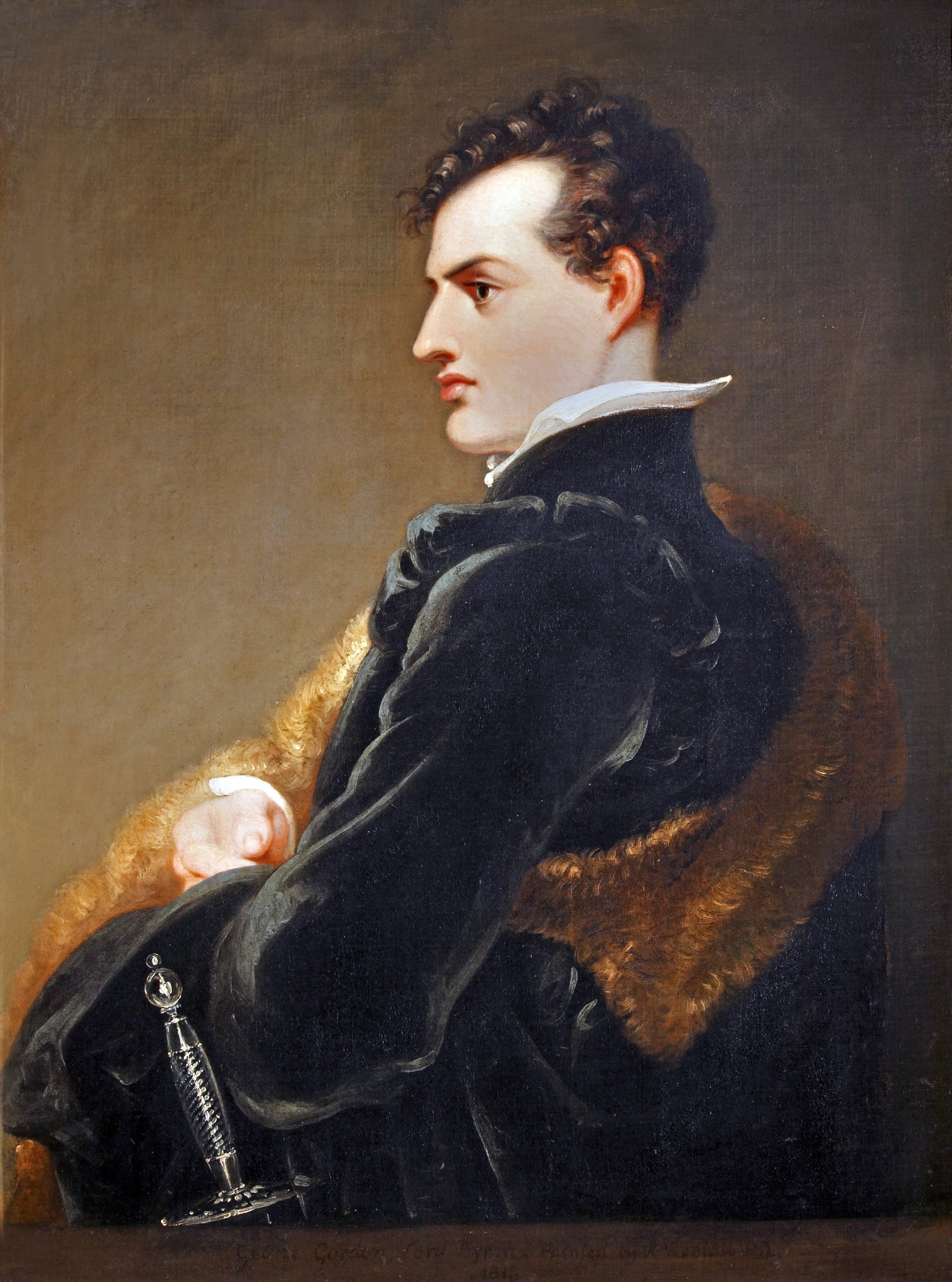
Source: Richard Westall (1765–1836), “George Gordon (1788–1824), Lord Byron,” 1813, oil on canvas, 124.5 × 104.1 cm (49 1/32 × 40 31/32 in.), Gift to the National Trust with Hughenden Manor by the Disraelian Society, 1947, accession number 428981, Hughenden Manor, The Disraeli Collection (National Trust), High Wycombe, Buckinghamshire
![Source: George Henry Harlow (1787–1819), “Lord Byron,” 1814–1815 (engraved by Henry Hoppner Meyer [1783–1847] and published at London by Henry Colburn [1784–1855] in New Monthly Magazine, August 1, 1815), black chalk drawing with touches of sanguin](https://images.squarespace-cdn.com/content/v1/68cea68d6d807265249ce83d/8cc868b0-239c-4b63-ac6a-a325b2c2d121/default+%281%29.jpg)
Source: George Henry Harlow (1787–1819), “Lord Byron,” 1814–1815 (engraved by Henry Hoppner Meyer [1783–1847] and published at London by Henry Colburn [1784–1855] in New Monthly Magazine, August 1, 1815), black chalk drawing with touches of sanguine, 11 × 8 cm (4 21/64 × 3 5/32), Carl H. Pforzheimer Collection of Shelley and His Circle, call number Pforz VMAT (Byron, G.) (1815. Meyer), The New York Public Library, New York
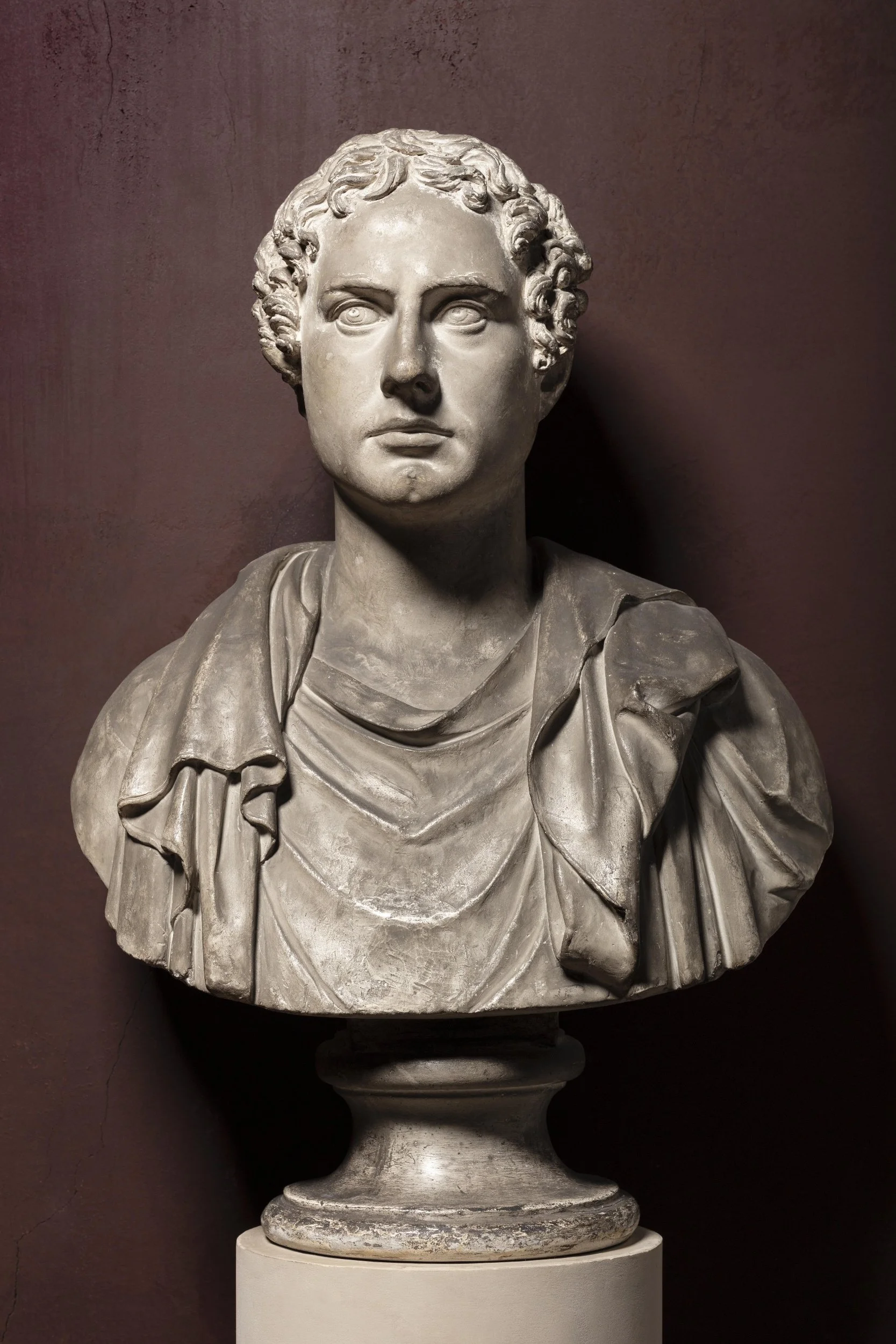
Source: Bertel Thorvaldsen (1770–1844), “George Gordon Byron (Original Model),” April 29, 1817–May 20, 1817, plaster cast portrait bust from initial clay sketch, 66.9 cm (26 11/32 in.) (height), Bequest from Bertel Thorvaldsen, March 24, 1844, accession number A257, Thorvaldsens Museum, Copenhagen
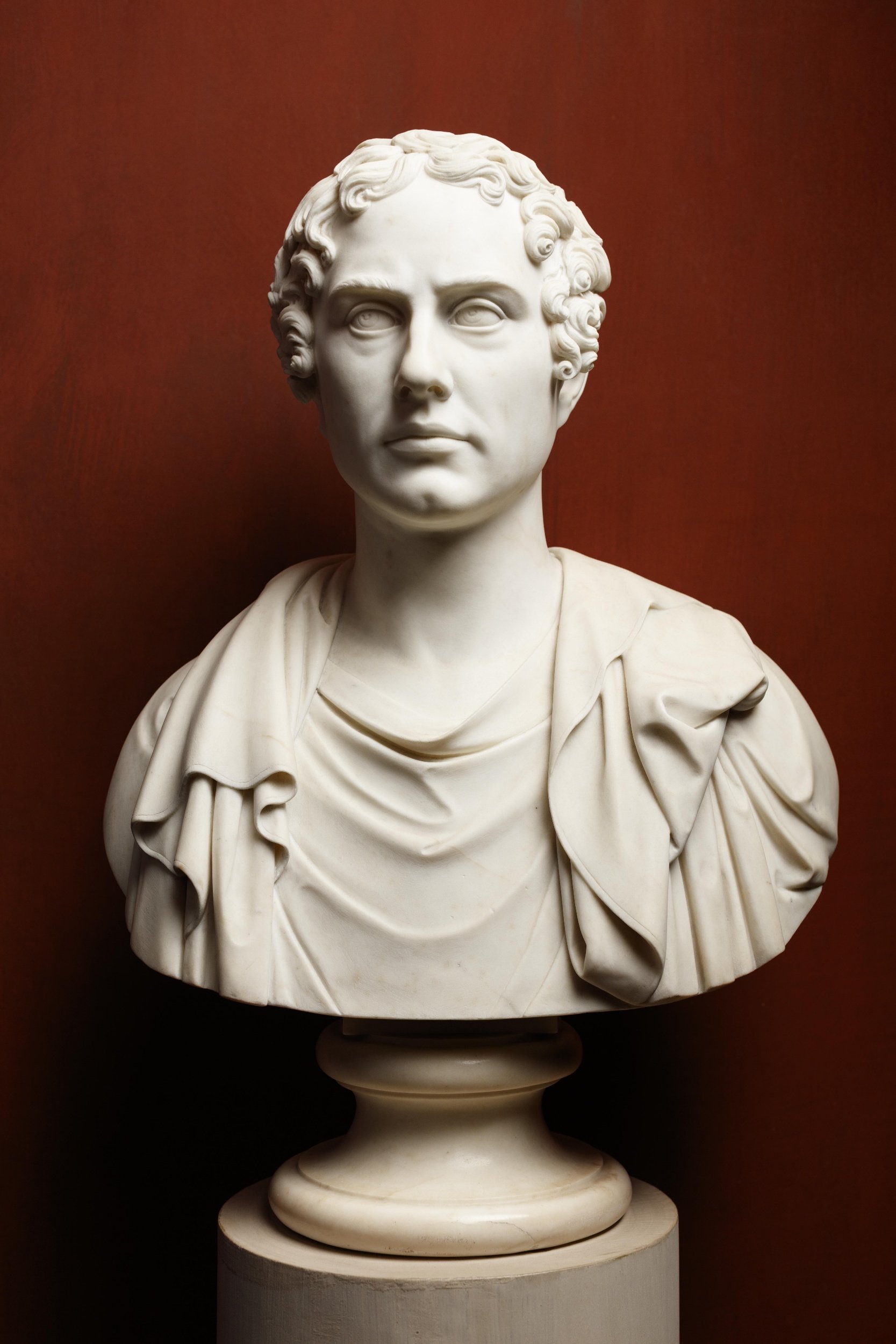
Source: Bertel Thorvaldsen (1770–1844), “George Gordon Byron (Marble Version),” May 1817 (production date presumably 1824), carved marble portrait bust, 65.3 cm (25 23/32 in.) (height), Commissioned by John Cam Hobhouse, Bequest from Bertel Thorvaldsen, March 24, 1844, accession number A256, Thorvaldsens Museum, Copenhagen
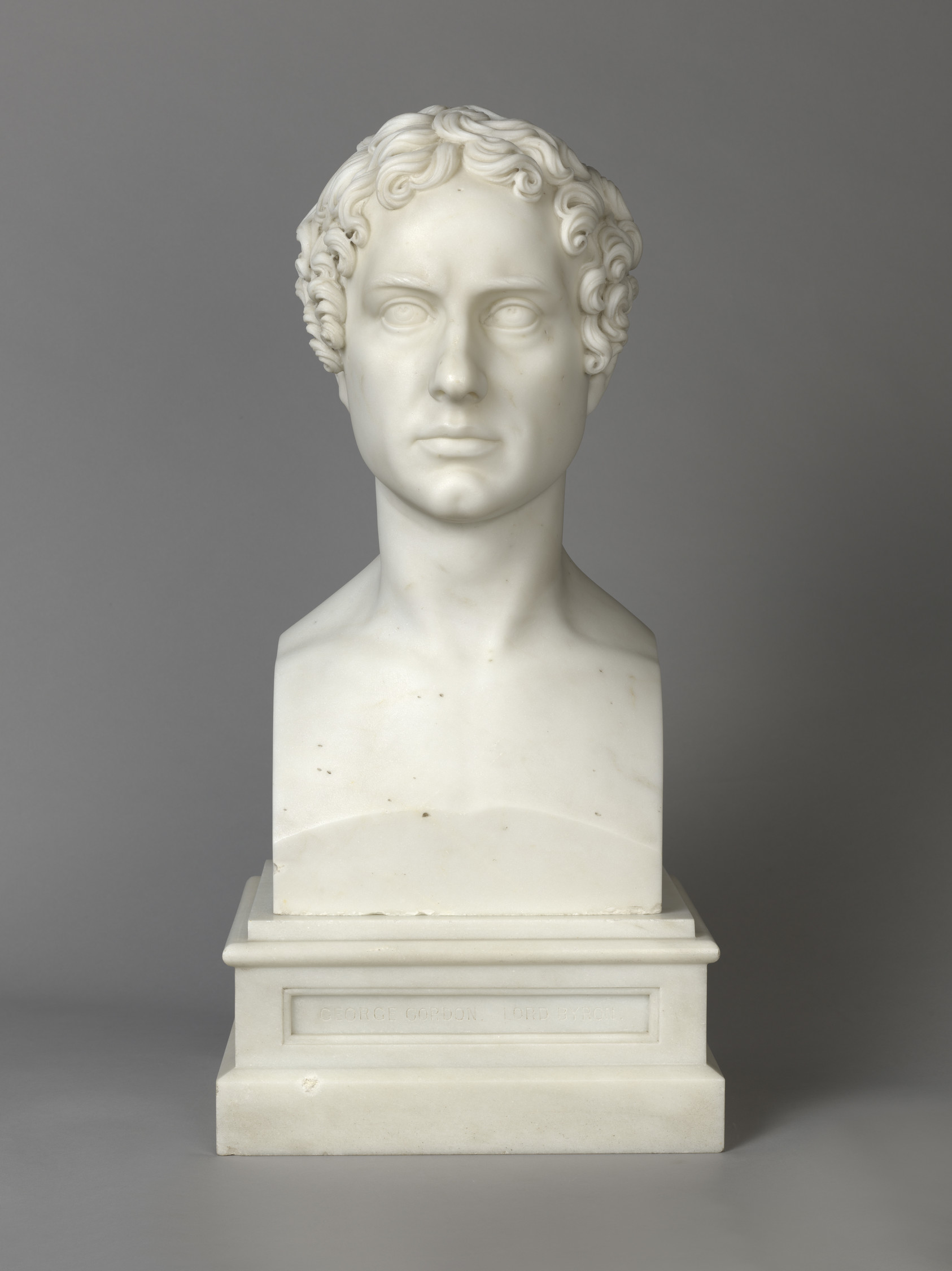
Source: Bertel Thorvaldsen (1770–1844), “George Gordon Byron (1788-1824), when 6th Baron Byron,” 1817, marble, 60.0 × 29.3 × 22.2 cm (23 ⅝ × 11 17/32 × 8 ¾ in.), Bequeathed to King George V in 1914 by Charlotte, Lady Dorchester, daughter of Lord Hobhouse, for whom the bust was modelled, accession number RCIN 35425, Royal Collection Trust, London (on view at Windsor Castle, Windsor); Copyright © His Majesty King Charles III

Source: Jean-Louis André Théodore Géricault (1791–1824), “Portrait d’homme (Byron),” circa 1820, oil on canvas, 61.5 × 50 cm (24 13/64 × 19 11/16 in.), Bequest of Alfred Bruyas, 1876, accession number 876.3.36, Musée Fabre de Montpellier Méditerranée Métropole (Fabre Museum of Montpellier Mediterranean Metropolis), Montpellier
![Source: Marianne ( née Kent) Hunt (1788–1857), “Silhouette of Lord Byron, as He Appeared After His Daily Ride at Pisa and Genoa,” 1822 (engraved by Samuel Freeman [1773–1857] and published at London by Rudolph Ackermann [1764–1834] in New Monthly M](https://images.squarespace-cdn.com/content/v1/68cea68d6d807265249ce83d/762ad402-2089-428d-8c89-e331956ec48e/processed_default+%2824%29.jpg)
Source: Marianne (née Kent) Hunt (1788–1857), “Silhouette of Lord Byron, as He Appeared After His Daily Ride at Pisa and Genoa,” 1822 (engraved by Samuel Freeman [1773–1857] and published at London by Rudolph Ackermann [1764–1834] in New Monthly Magazine, October 6, 1826), cut paper silhouette, 25.3 × 25.3 cm (9 1/32 × 9 1/32 in.), Carl H. Pforzheimer Collection of Shelley and His Circle, call number Pforz (FF. A-0004), The New York Public Library, New York
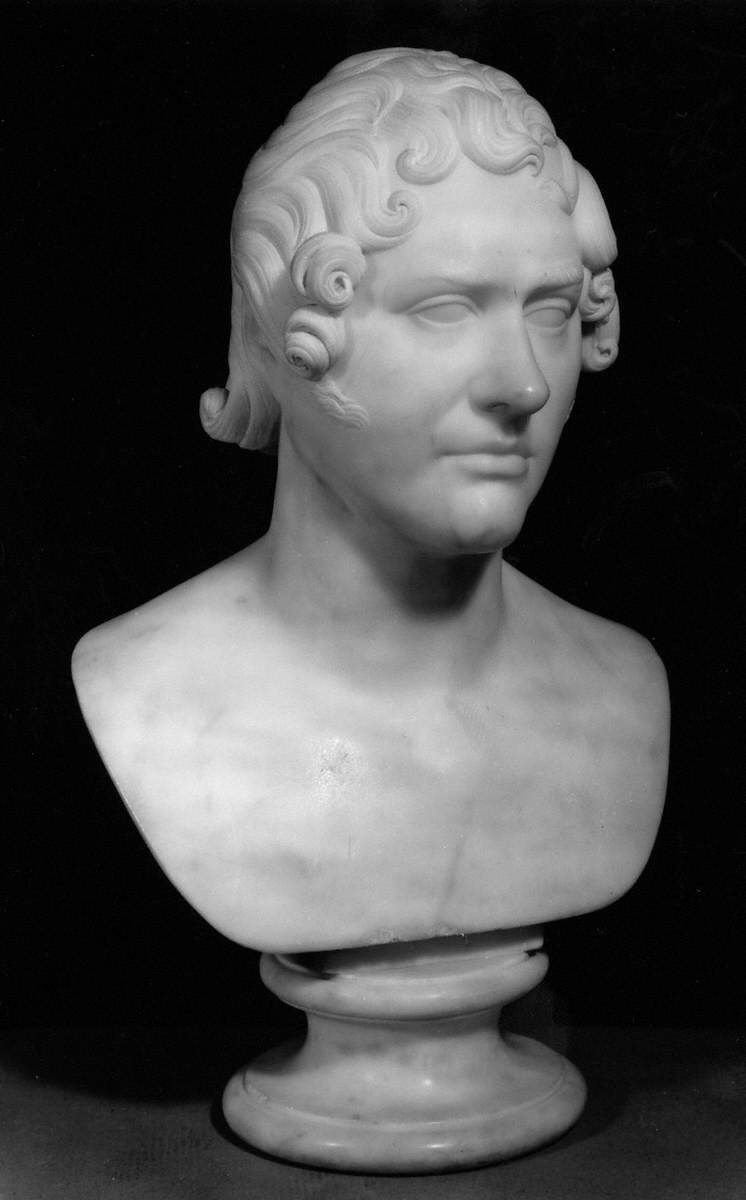
Source: Lorenzo Bartolini (1777–1850), “Lord Byron,” 1822, marble, 59.5 × 34.5 cm (23 ⅜ × 13 ⅝ in.), Purchased, 1904, Primary Collection, accession number NPG 1367, National Portrait Gallery, London
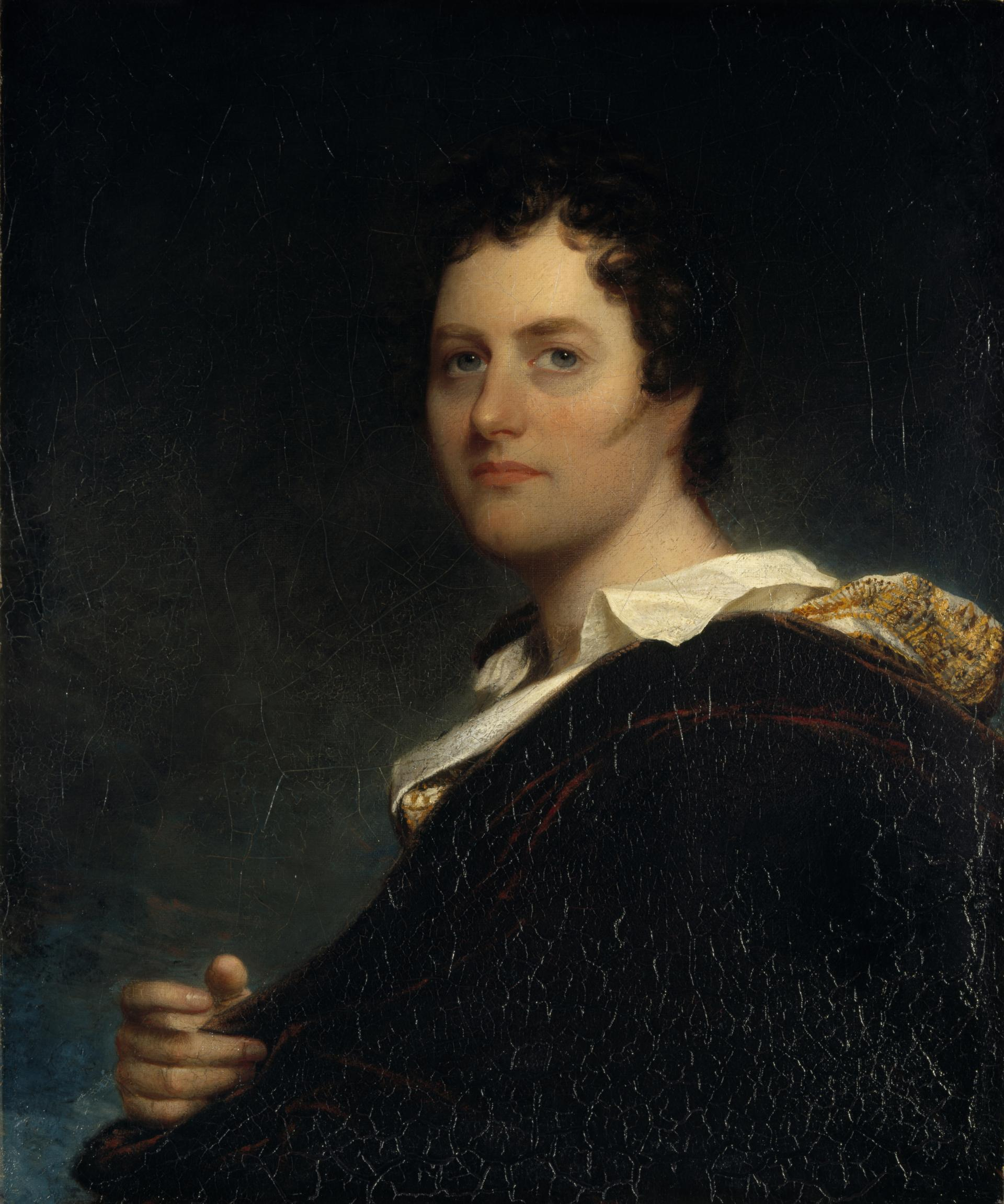
Source: William Edward West (1788–1857), “George Gordon, 6th Lord Byron, 1788–1824, Poet,” 1822, oil on canvas, 72.40 × 62.20 cm (28 ½ × 24 ½ in.), Presented by Colonel William Stirling of Keir, 1951, accession number PG 1561, National Galleries of Scotland, Edinburgh
![Source: Alfred Guillaume Gabriel D’Orsay, Comte D’Orsay (1801–1852), “Lord Byron (1788–1824) [at Genoa],” 1823, pencil drawing on paper, 21.27 × 16.51 cm (8 ⅜ × 6 ½ in.), Forster Bequest, accession number F.60, V&A South Kensington, Victoria and Albe](https://images.squarespace-cdn.com/content/v1/68cea68d6d807265249ce83d/bc432435-56a5-4fdf-a5a5-5f8ee460bcdf/2009CR8743.jpg)
Source: Alfred Guillaume Gabriel D’Orsay, Comte D’Orsay (1801–1852), “Lord Byron (1788–1824) [at Genoa],” 1823, pencil drawing on paper, 21.27 × 16.51 cm (8 ⅜ × 6 ½ in.), Forster Bequest, accession number F.60, V&A South Kensington, Victoria and Albert Museum, London
![Source: Alfred Guillaume Gabriel D’Orsay, Comte D’Orsay (1801–1852), “Lord Byron [at Genoa],” May 1823 (lithographed by Graf & Soret [ floruit 1830–1838] and printed at London by Richard Bentley [1871–1898] for publisher Henry Colburn [ circa 1785–](https://images.squarespace-cdn.com/content/v1/68cea68d6d807265249ce83d/13987fff-e890-4638-a74d-2dfd4d889531/1612929996+%281%29.jpg)
Source: Alfred Guillaume Gabriel D’Orsay, Comte D’Orsay (1801–1852), “Lord Byron [at Genoa],” May 1823 (lithographed by Graf & Soret [floruit 1830–1838] and printed at London by Richard Bentley [1871–1898] for publisher Henry Colburn [circa 1785–1855], December 2, 1833), pencil drawing on paper, 15.2 × 13.5 cm (5 63/64 × 5 5/16 in.), Purchased from A. E. Evans & Sons, 1859, accession number 1859,0709.1088, British Museum, London
![Source: Alfred Guillaume Gabriel D’Orsay, Comte D’Orsay (1801–1852), “Lord Byron [at Genoa],” May 1823 (lithographed 1832), pencil drawing on paper, 15.2 × 13.5 cm (5 63/64 × 5 5/16 in.), Purchased from Robert Jackson, 1893, accession number 1893,051](https://images.squarespace-cdn.com/content/v1/68cea68d6d807265249ce83d/5efd074c-aaac-4b8c-bf6d-0085fdc77ee2/1612929994+%281%29.jpg)
Source: Alfred Guillaume Gabriel D’Orsay, Comte D’Orsay (1801–1852), “Lord Byron [at Genoa],” May 1823 (lithographed 1832), pencil drawing on paper, 15.2 × 13.5 cm (5 63/64 × 5 5/16 in.), Purchased from Robert Jackson, 1893, accession number 1893,0516.227, British Museum, London
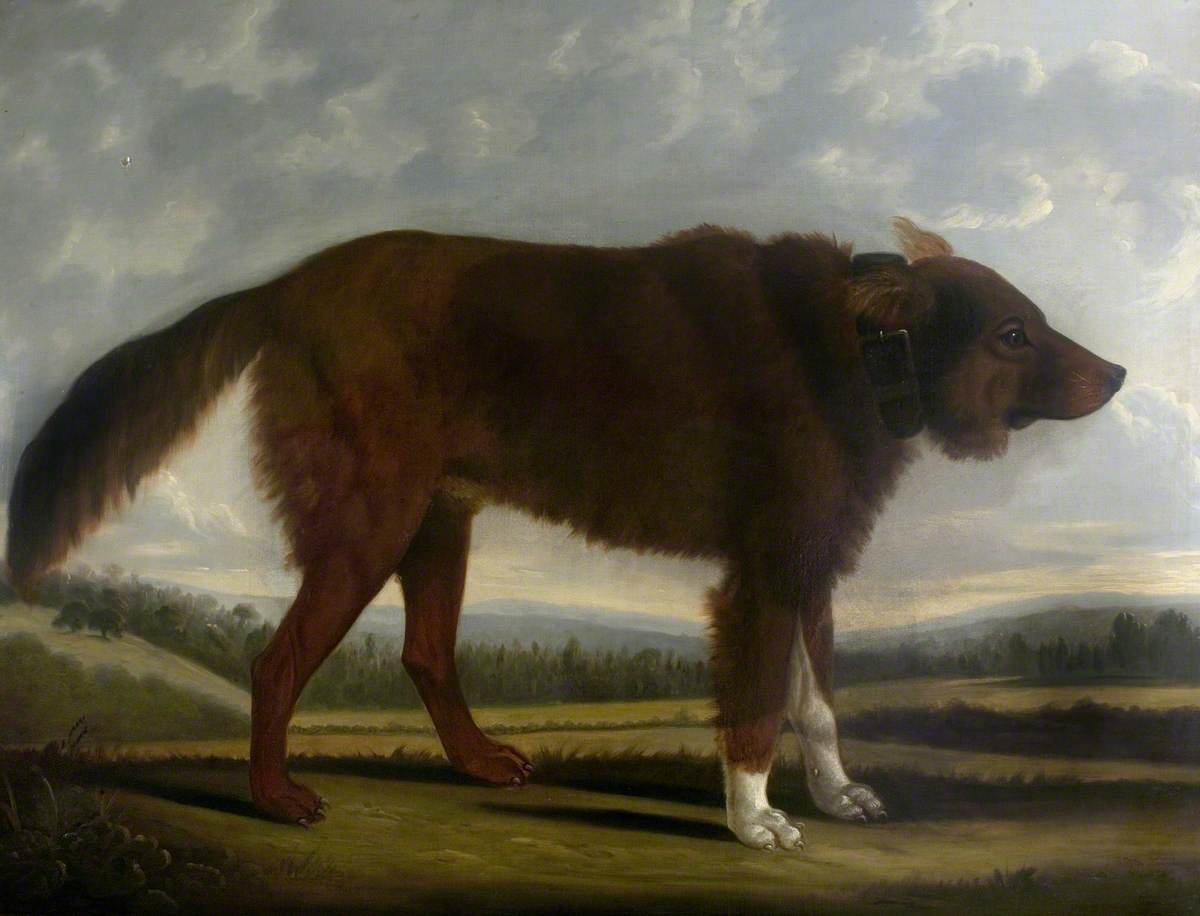
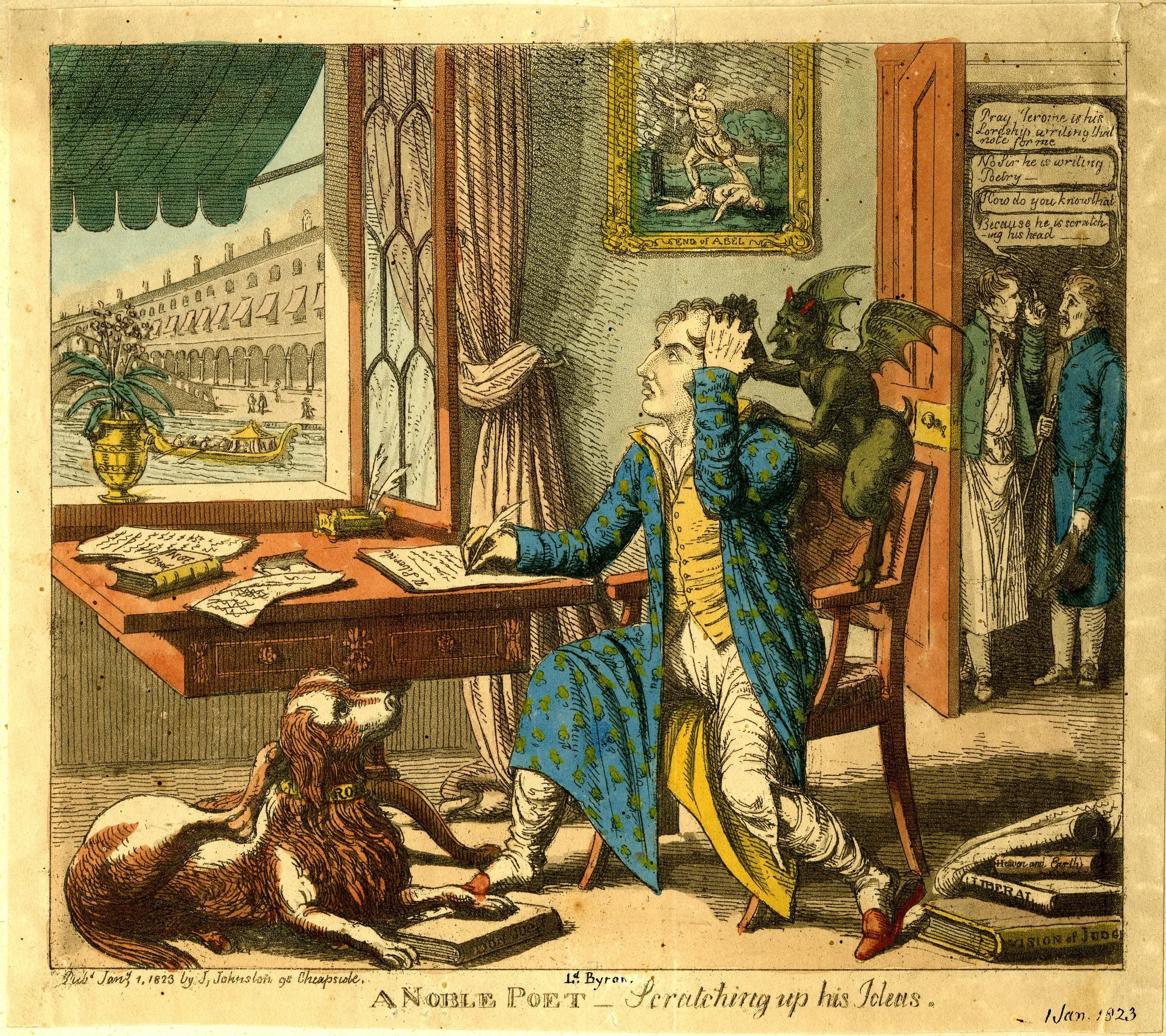
Source: Clifton Tomson (1775–1828), “Lord Byron’s Dog ‘Lyon’ (The Wolf Dog),” 1808, oil on canvas, 135 × 171 cm (53 5/32 × 67 5/16 in.), Gift from Charles Ian Fraser, 1931, accession number NA 277, Newstead Abbey, Nottingham City Museums & Galleries, Nottingham City Council, Ravenshead, Nottinghamshire
![Source: William Parry (1773–1859), “‘Lyon you are no rogue Lyon’ (Frontispiece to William Parry’s The Last Days of Lord Byron ),” 1825 (etched by Robert Seymour [1798–1836] and published at London by Knight and Lacey [ floruit 1823–1828] in 1825),](https://images.squarespace-cdn.com/content/v1/68cea68d6d807265249ce83d/9a568350-2721-4b0c-b2e1-4a75c1ebb5fe/49a-pc.jpg)
Source: William Parry (1773–1859), “‘Lyon you are no rogue Lyon’ (Frontispiece to William Parry’s The Last Days of Lord Byron),” 1825 (etched by Robert Seymour [1798–1836] and published at London by Knight and Lacey [floruit 1823–1828] in 1825), pencil drawing on paper, 13 × 11 cm (5 ⅛ × 4 21/64 in.), The Corvey Collection, Special Collections & University Archives, call number PR4382.A3 P26 L3 1825, The Bancroft Library, University of California Berkeley, Berkeley, California
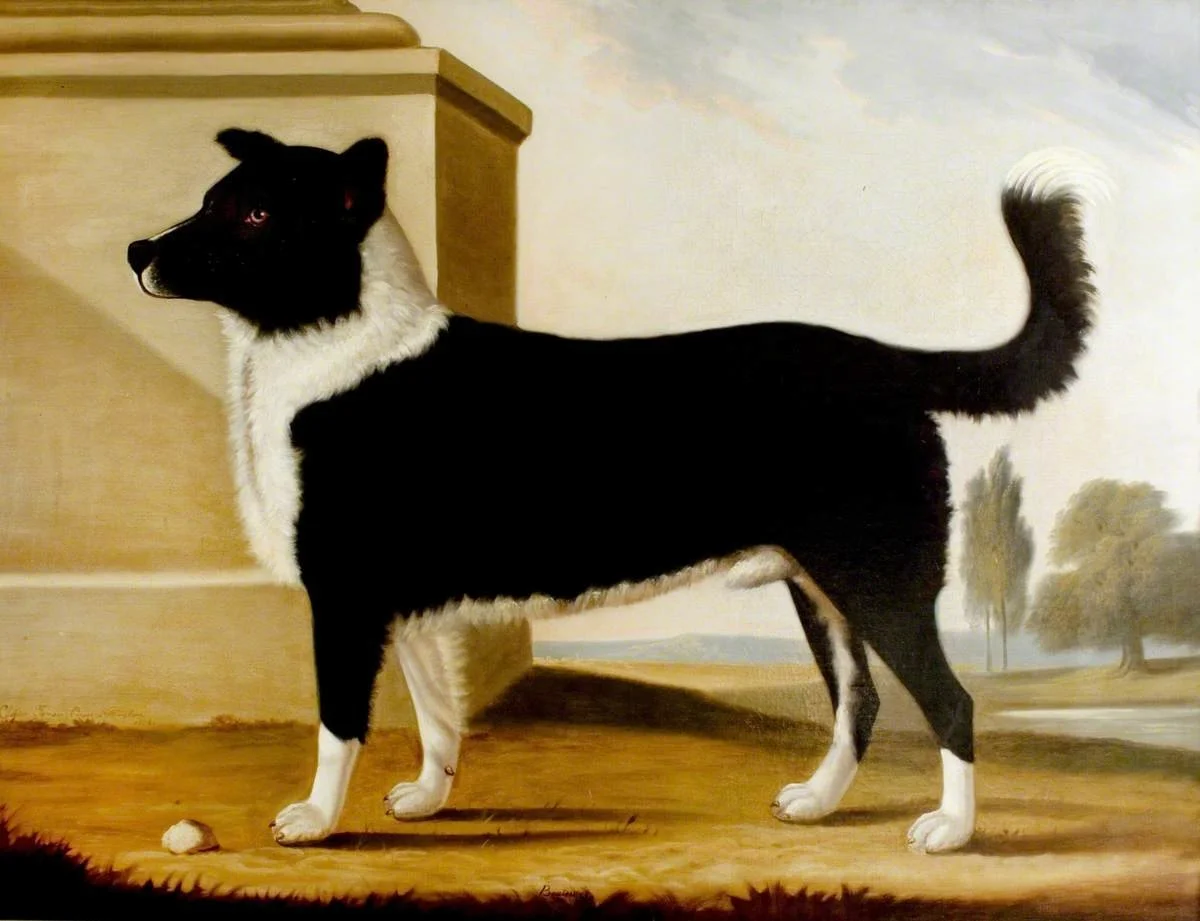
Source: Clifton Tomson (1775–1828), “Lord Byron’s Dog ‘Boatswain’ (1803–1808) (The Newfoundland),” 1808, oil on canvas, 135 × 171 cm (53 5/32 × 67 5/16 in.), Gift from Charles Ian Fraser, 1931, accession number NA 245, Newstead Abbey, Nottingham City Museums & Galleries, Nottingham City Council, Ravenshead, Nottinghamshire
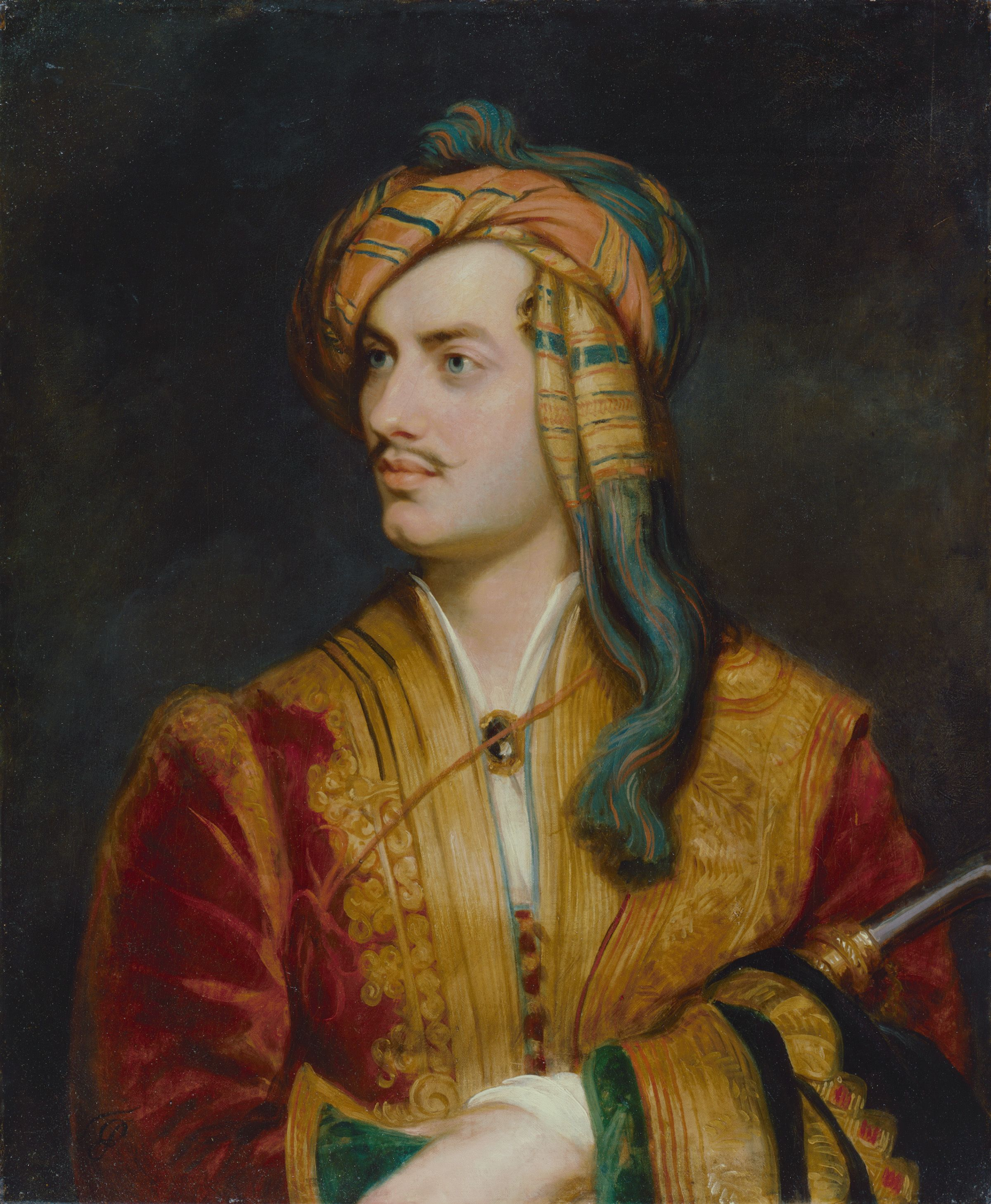
Source: Thomas Phillips (1770–1845), “Lord Byron,” circa 1835 (replica, based on a work of 1813, by the same artist), oil on canvas, 76.5 × 63.9 cm (30 ⅛ × 25 ⅛ in.), Purchased, 1862, Primary Collection, accession number NPG 142, National Portrait Gallery, London
Lines Imitating Life.
Who even speaks this way?
The title and taglines are taken from Byron’s poetry and letters. Much of the film’s action and dialogue has been adapted from his personal correspondence and private journals, the best and most immediate source of Byron’s lived experience; in which he confided firsthand and without reservation, while demonstrating his many contradictions, all with formidable wit.
✺
Between 1973 and 1981, Leslie A. Marchand—the foremost of Byron’s biographers, whose 1957 three-volume doorstop remains standard (bested since only by Fiona McCarthy’s rigorous, uncensored study in 2002)—published 12 volumes of the poet’s then-known letters. In 1994, a thirteenth volume from Marchand came out with newly discovered correspondence. Altogether 3,000 letters, in fact.
✺
Helpful, most of all, though, is that, nearing the end of his brief-yet-meteoric and anything-but-mediocre life, Byron in exile sat for two book-length conversations—the closest we have to interviews with the legend himself. History’s first celebrity speaking freely, in his own words, about any subject posed to him, by a man and a woman.
✺
Thomas Medwin and Countess Blessington’s volumes, 1824 and 1834 respectively. Instant bestsellers. By 1954, Ernest J. Lovell compiled all other surviving transcripts and accounts of Byron’s dialogues others had preserved, so we know not only how the poet spoke to those who knew him, but what he thought about more-or-less everyone and everything, unapologetically unfiltered.
✺
Notate Bene:
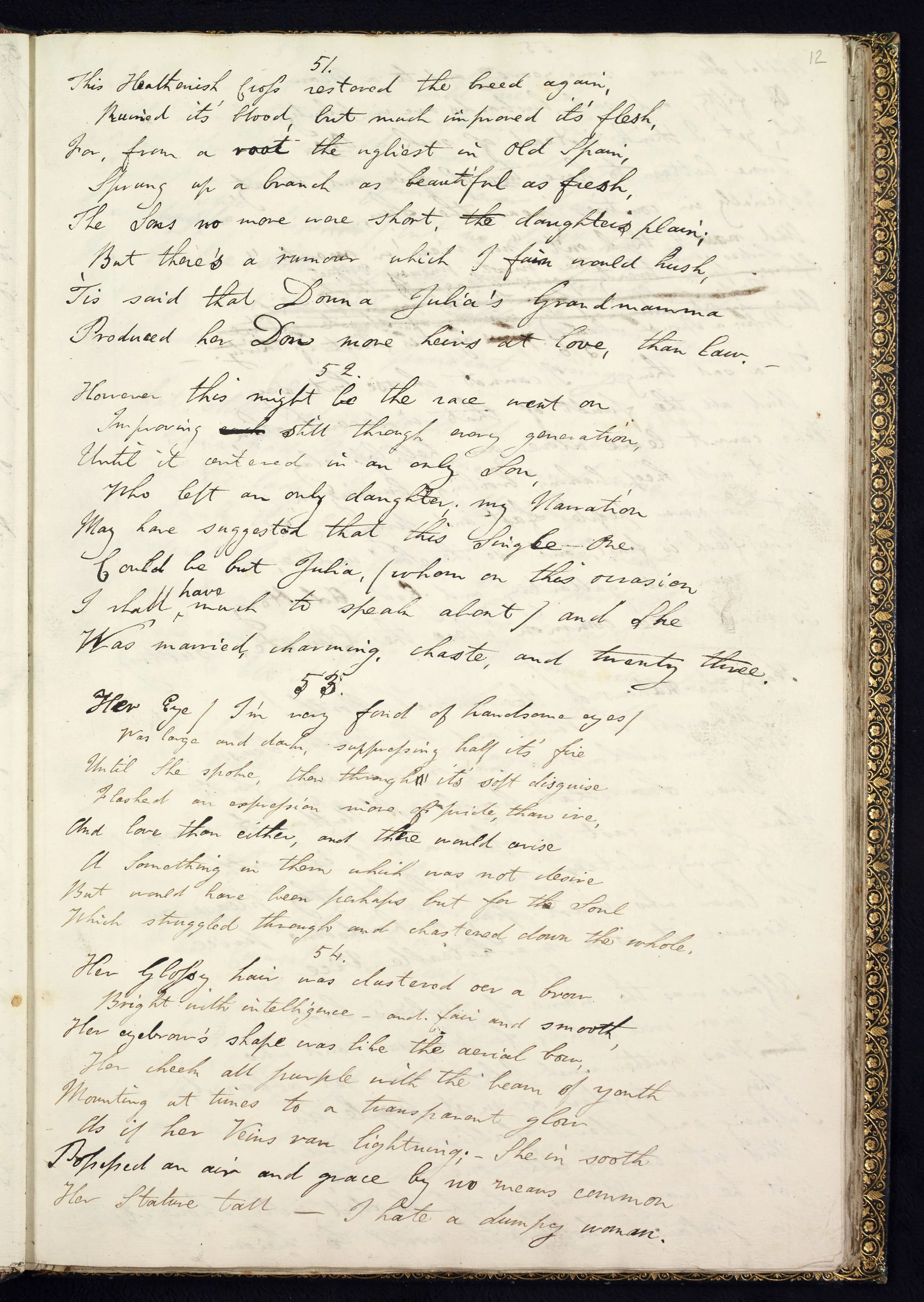
☞ The title of the film is taken from Lord Byron, Don Juan, Canto I, Stanza 61, Line 6 (Line 486 overall of the Canto), in Don Juan: Edited by T. G. Steffan, E. Steffan and W. W. Pratt: With an Introduction by Susan J. Wolfson and Peter J. Manning, published at London by Penguin Books in 2004; page 61. ¶ The movie’s taglines are taken from Byron’s writings, public and private; “Chaos fills the void” is from Childe Harold’s Pilgrimage, the poem that made him famous overnight, and “Cut a path or perish” is from a letter he wrote to his mother. Childe Harold’s Pilgrimage, Canto IV, Stanza 80, Line 7 (Line 718 overall of the Canto), in The Major Works: Edited with an Introduction and Notes by Jerome J. McGann, published at New York by Oxford University Press in 2000; page 171; and Lord Byron, to his mother Mrs. Catherine Gordon Byron, written at and sent from Harrow-on-the-Hill on May 1st–10th, 1804, printed in Leslie A. Marchand’s Byron’s Letters and Journals, Volume I: ‘In my hot youth,’ 1798–1810, published at Cambridge, Massachusetts by Harvard University Press in 1973; page 49. ¶ The background image is the source of the film’s title, in Byron’s own hand, from his manuscript for Don Juan, written at Venice from July 3rd, 1818 through September 6th, 1818, and preserved as Manuscript 50000, folio 12 recto, in the collection of the National Library of Scotland at Edinburgh. Before his numerous edits, deletions, and additions, it was originally numbered by him as Stanza 54 of Canto I of his most controversial poem, of which his first draft of Line 6 reads: “As if her Veins ran lightning;—She in sooth[…]”
Historical Timeline.
Fame, Desire, and the Fall
Seven Defining Moments in Byron’s Myth
Byron’s Life at a Glance
Explore the key moments that defined Lord Byron’s real-life journey, from his meteoric rise to fame to his tumultuous love affairs and eventual exile. This timeline offers insight into the historical events that shaped the man behind the legend. Note that this is not a representation of the film’s nonlinear narrative, which explores Byron’s life and myth through fragmented, artistic expression.
I. Birth of a Scandal: The Enigmatic Origins (1788)
Byron’s birth marked the start of a life shadowed by scandal—his father's debts, his mother’s fierce temper, and the deformity that would haunt him. The seeds of isolation were sown early, setting the stage for a poet whose greatness would never escape the weight of his lineage.
II. Cambridge: The Blossoming of Desire and Rebellion (1805–1808)
At Cambridge, Byron’s intellectual rebellion and secret passions began to take form. It was here that his first forbidden loves—particularly toward fellow male students—ignited the fire that would both fuel his poetry and haunt his soul.
III. The Early Celebrity: The Rise of One So “Mad, Bad, and Dangerous to Know” (1812–1816)
Byron became a literary icon overnight with Childe Harold, but his fame soon became a gilded cage. Scandal erupted with his marriage to the intellectual Annabella, his affair with his half-sister Augusta, and the births of legitimate Ada and incestuous Medora. His growing reputation for forbidden love, including rumors of male affairs, led to his forced exile. In the apocalyptic summer of 1816, Byron’s Fragment of a Novel birthed the first English vampire story, forever intertwining his legacy with the darkness of gothic myth.
IV. The Tumultuous Love Affair with Teresa Guiccioli: A Darker Romance (1819–1823)
In exile, Byron’s affair with Teresa Guiccioli offered fleeting solace, but the darkness of his soul remained. Their love, intense and turbulent, mirrored his deepening isolation and unspoken desires for men. In Italy, Byron was not just a poet—he was a man broken by his own contradictions, caught between love and exile.
V. The Greek Revolution: A Hero’s Last Stand (1823–1824)
Byron’s final act was a heroic, yet tragic, plunge into the Greek War of Independence. Leaving behind the comforts of fame, he sought redemption in battle—but his body, worn by fever and exhaustion, ultimately failed him. Byron’s death in Missolonghi sealed his mythic status, both a poet and a warrior lost to history.
VI. The Secret of His Heart: Forbidden Desires in the Shadows (Various Periods)
Byron’s heart was forever torn between his public persona and his private, forbidden loves. His relationships with men—intense, passionate, and unspoken—ran like a dark thread throughout his life, shaping both his work and his inner torment.
VII. The Final Rejection: Death as Liberation (1824)
Byron’s death at 36 marked the ultimate rebellion—an escape from a world that never truly understood him. In death, he became more than a poet—he became an immortal icon, free from the judgments of society, his desires forever obscured by myth.
English Bards and Scotch Reviewers
(London: James Cawthorn, 1809)
A savage satire, lashing critics, society’s hypocrisy, and Byron’s own restless genius.
Childe Harold’s Pilgrimage
(London: John Murray, 1812–1818)
A melancholic journey through ruin, self-doubt, and the intoxicating allure of solitude.
The Corsair
(London: John Murray, 1814)
A pirate’s dark romance, filled with passion, betrayal, vengeance, and doomed heroism.
The Prisoner of Chillon
(London: John Murray, 1816)
Tragic imprisonment, soul-bound to stone, reflecting eternal defiance against tyrannical forces.
Manfred
(London: John Murray, 1817)
A brooding, tormented soul seeks redemption through dark, mystical forces and guilt.
A Fragment of a Novel
(London: John Murray, 1819)
The first vampire story in English—an exploration of seduction, decay, and immortality.
Don Juan
(London: John Murray, 1819–1822; John Hunt, 1822–1824)
Subversion of desire, exploring love’s fluidity, gender, and the chaos of passion.
Founded in 1768, John Murray Publishers is the original publisher of Lord Byron, Jane Austen, and Charles Darwin’s (r)evolutionary The Origin of Species. Today, John Murray continues its legacy of quality and accessibility, publishing works in literary fiction, history, current affairs, business, and science. As a subsidiary of Hachette Livre, a division of Lagardère Publishing, John Murray is ultimately owned by Lagardère Group.
✺
Not only was John Murray II (1778–1843), son of the firm’s founder, Byron’s literary conduit—bridging the gap between the poet’s world and the public—but also a figure deeply woven into Byron’s personal saga, serving as confidant and counselor. It was in Murray’s offices at 50 Albemarle Street, London—where the firm would remain for 191 years—after Byron’s death, that the long-suffering editor made the fateful decision to destroy both volumes of Byron’s uncensored memoirs, which had been entrusted to him. In an attempt to protect Byron’s reputation, Murray consigned these controversial writings to the flames. This act remains one of the greatest losses in literary history, as we will never know what Byron truly wished to reveal about himself. Murray had moved the firm to this address in 1812, following the success of Byron’s Childe Harold’s Pilgrimage, forever linking it with the poet’s legacy.
✺
In 2002, the world’s oldest independent publisher at the time, John Murray was sold to Hachette. The John Murray Archive & Publishers’ Collections, including its voluminous holdings of Byron’s manuscripts, fan mail, and memorabilia, were acquired by the National Library of Scotland in 2006, where they can now be accessed by researchers.
Note on Artistic Interpretation
While this timeline highlights key moments of Lord Byron’s life, the film takes an artistic, nonlinear approach to tell his story. The narrative will weave between moments of his public persona and private desires, exploring his complexities as a man caught between fame, romance, and the horror of his own legend.
Escape the horror of your own myth.

His Very Self and Voice.
Whispers in the Veins
Saying his name, speaking his words, gives him eternal life.
Bow Down: Enter the Communion of His Wounded Voice
Entering Byron’s mind is like wandering the chambers of a ruined abbey, where the Self stands revered, yet fraught with eternal conflict and contradiction. Tour some of the bard’s most biting barbs.
✺ Tortured Genius
The artist’s internal strife and suffering.
“The great object of life is Sensation—to feel that we exist, even though in pain. It is this ‘craving void’ which drives us[.]”
✺ Wicked Wisdom
Byron’s biting intellect and social critique.
“But words are things, and a small drop of ink,
Falling like dew, upon a thought, produces
That which makes thousands, perhaps millions, think[.]”
✺ Rebellious Reverence
His respect for greatness, but with an edge.
“In worship of an echo; in the crowd
They could not deem me one of such; I stood
Among them, but not of them; in a shroud
Of thoughts which were not their thoughts[.]”
✺ Ego Unbound
The self-promotion and grandiosity that fueled his myth.
“With false ambition what had I to do?
Little with love, and least of all with fame;
And yet they came unsought and with me grew,
And made me all which they can make—a Name.”
✺ Romantic Despair
The melancholy and heartache of Byron’s love life.
“Rose late—dull and drooping—the weather dripping and dense. […]Hear the carriage—order pistols and great coat, as usual—necessary articles. […]Clock strikes—going out to make love. Somewhat perilous, but not disagreeable.”
✺ Occult Echoes
His fascination with the supernatural and the mysterious.
“I sometimes think that Man may be the relic of some higher material being wrecked in a former world—and degenerated in the hardships and struggle through Chaos and Conformity—or something like it[.]”
✺ Cynical Clarity
His brutal, disillusioned perspective on the world.
“All the world are to be at the [party] to-night, and I am not sorry to escape any part of it. I only go out to get me a fresh appetite for being alone.”
Read, and summon Byron to his reawakening.
Participate in his myth-making.
✺
Notate Bene:
¹Lord Byron, in a letter to Annabella Milbanke, written at and sent from London on Monday, September 6th, 1813, printed in Leslie A. Marchand’s Byron’s Letters and Journals, Volume III: ‘Alas! the love of women,’ 1813–1814, published at Cambridge, Massachusetts by Harvard University Press in 1974; page 109.
²Lord Byron, Don Juan, Canto III, Stanza 88, Lines 1–3 (Lines 793–795 overall of the Canto), in The Major Works: Edited with an Introduction and Notes by Jerome J. McGann, published at New York by Oxford University Press in 2000; page 513.
³Lord Byron, Childe Harold’s Pilgrimage, Canto III, Stanza 113, Lines 5–8 (Lines 1053–1056 overall of the Canto), in The Major Works: Edited with an Introduction and Notes by Jerome J. McGann, published at New York by Oxford University Press in 2000; page 137.
⁴Lord Byron, “Epistle to Augusta,” Stanza 13, Lines 1–4 (Lines 97–100 overall), in “Poetry” of “Part Three: Exile on Lake Geneva (April–October 1816)” in “Byron’s Poetry and Prose” of Byron’s Poetry and Prose: Authoritative Texts [and] Criticism: Selected and Edited by Alice Levine[,] Hofstra University, published at New York by W. W. Norton & Company in 2010; page 244.
⁵Lord Byron, in his journal, written at Ravenna on Friday, January 5th, 1821, printed in Leslie A. Marchand’s Byron’s Letters and Journals, Volume VIII: ‘Born for opposition,’ 1821, published at Cambridge, Massachusetts by Harvard University Press in 1978; page 13.
⁶Lord Byron, “[Detached Thought] 101,” in My Dictionary and Detached Thoughts, a manuscript commonplace book he composed and compiled from October 15th, 1821 through May 18th, 1822, preserved as Accession 12604 / 4057, folio 140, in the collection of the National Library of Scotland at Edinburgh, printed in Leslie A. Marchand’s Byron’s Letters and Journals, Volume IX: ‘In the wind’s eye,’ 1821–1822, published at Cambridge, Massachusetts by Harvard University Press in 1979; pages 46–47.
⁷Lord Byron, in his journal, from an entry dated Sunday, December 12th, 1813, printed in Leslie A. Marchand’s Byron’s Letters and Journals, Volume III: ‘Alas! the love of women,’ 1813–1814, published at Cambridge, Massachusetts by Harvard University Press in 1974; page 238.
The Starry Circle.
Entwined in Darkness
Byron’s circle was a constellation of broken stars—each one drawn to his light, only to be consumed by its brutal brilliance. Here, we glimpse the faces of those who burned with him in his eternal night.
✺
To live alongside Lord Byron was to be swept up in a storm of beauty and horror. His loves were fierce, his friendships passionate, and his obsessions all-consuming. These are the faces of those who stood beside him in the dark—forever linked to the poet whose genius and madness left an indelible mark on their souls.
✺
Byron’s world was one of brilliance, but also of ruin. This was the constellation of broken stars who orbited him, consumed by his light, forever altered by the dark genius that burned at their core.
The Carnival of Decay
An eerie, chaotic circus of minds, strange and potent in their tragic beauty,
where each character is both performer and the haunted audience of their own undoing.
-
![A historical painting of a man in a military uniform with a modern person's face, wearing a white and black military coat with gold epaulets and medals.]()
The Exiled Titan
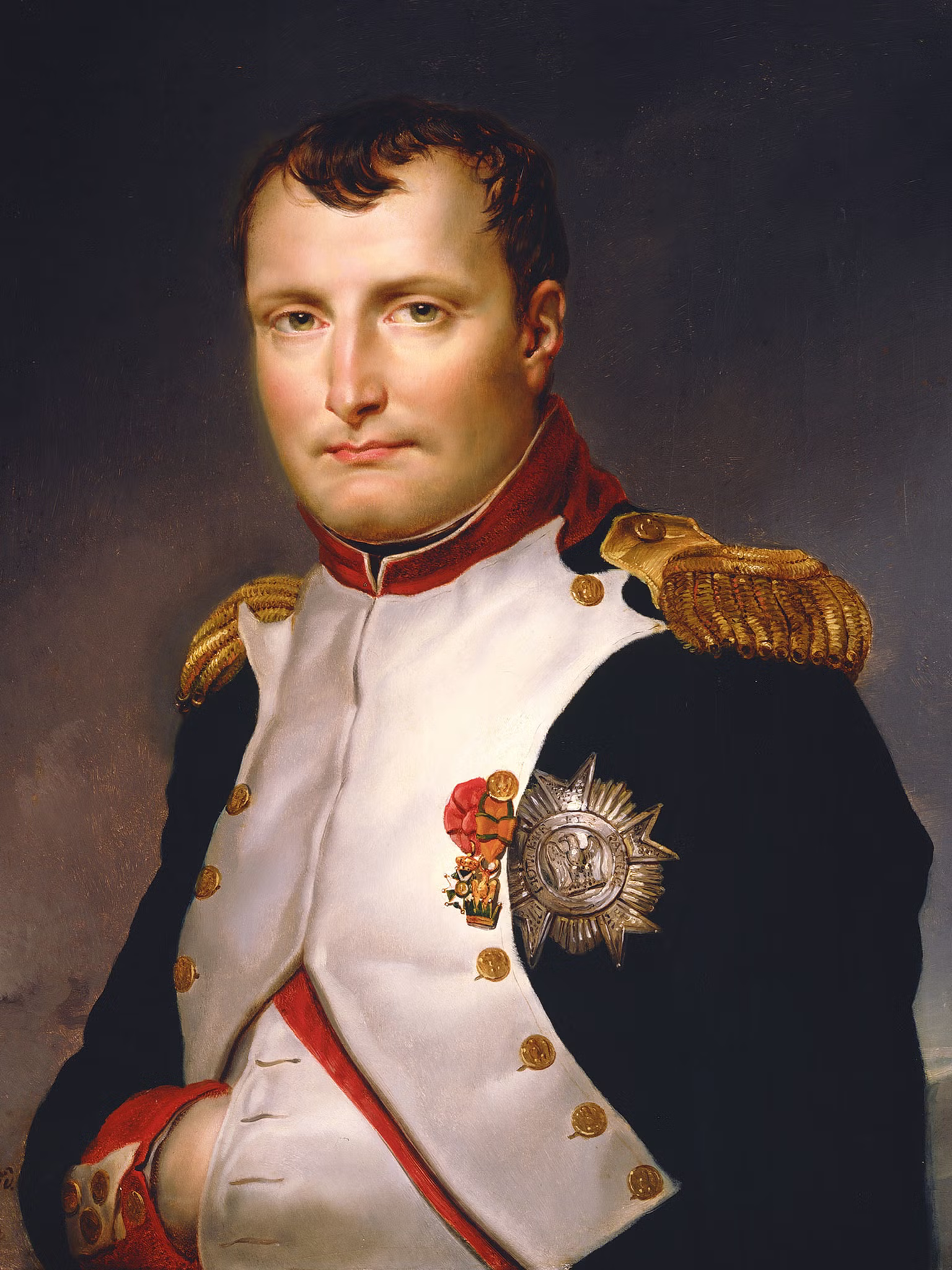
Napoléon Bonaparte
(1769–1821)Napoléon, once a conqueror of empires, became Byron’s idol of defiance. Exiled twice, including his final retreat to St. Helena, his boundless ambition and literary aspirations mirrored Byron’s own rise and collapse, each a symbol of revolution, genius, and inevitable ruin.
Source: Jacques-Louis David (1748–1825), “Napoléon Bonaparte (Napoléon I, Emperor of the French), in the Uniform of the National Guard, Pledges to Protect the French from the Invasion of the British and Prussians,” 1813, oil on canvas, 64 × 53.5 cm. (25 13/64 × 21 1/16 in.), Bequest of Eva Sardinia Borthwick-Norton to The Royal Scottish Academy of Art and Architecture, Edinburgh, 1988, Purchased from The Royal Scottish Academy of Art and Architecture, Edinburgh, 2005, Private Collection
-
![Painting of a man with blond hair wearing a dark coat and a yellow waistcoat, standing against a dark background.]()
The Monumental Bard
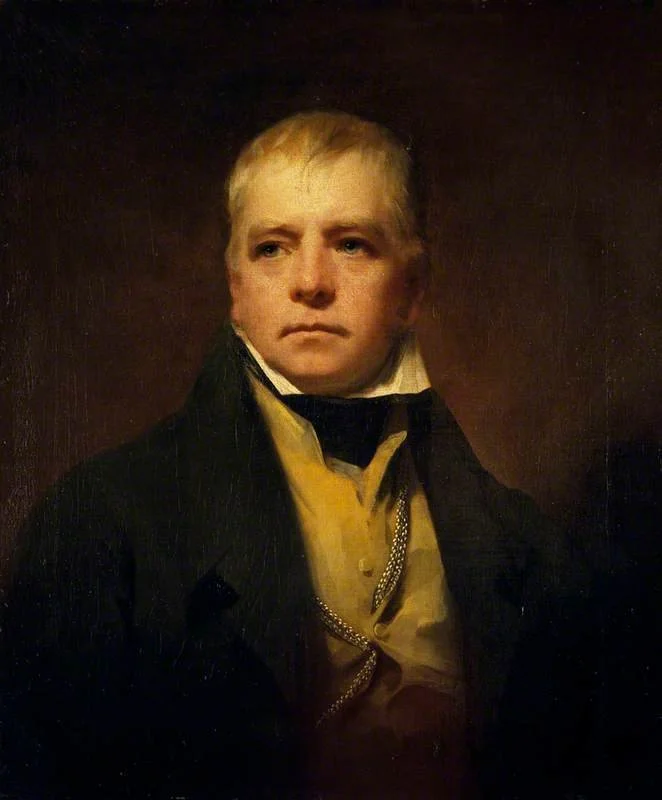
Walter Scott
(1771–1832)Byron, the torchbearer of a new literary revolution, looked to Scott with deep respect, though their worlds were worlds apart. Scott, the poet of tradition and empire, was forever tethered to the past—his legacy both revered and outpaced by the fire of youth.
Source: Henry Raeburn (1756–1823), “Sir Walter Scott (1771–1832), Novelist and Poet,” 1822, oil on canvas, 76.2 × 63.5 cm (30 × 25 in.), Purchased with the assistance of the Art Fund, 1935, accession number PG 1286, National Galleries of Scotland: Portrait, Edinburgh
-
![A young girl with blonde hair, blue eyes, wearing a white dress and red necklace, sitting at a table with a bouquet of pink and blue flowers.]()
The Elusive Echo
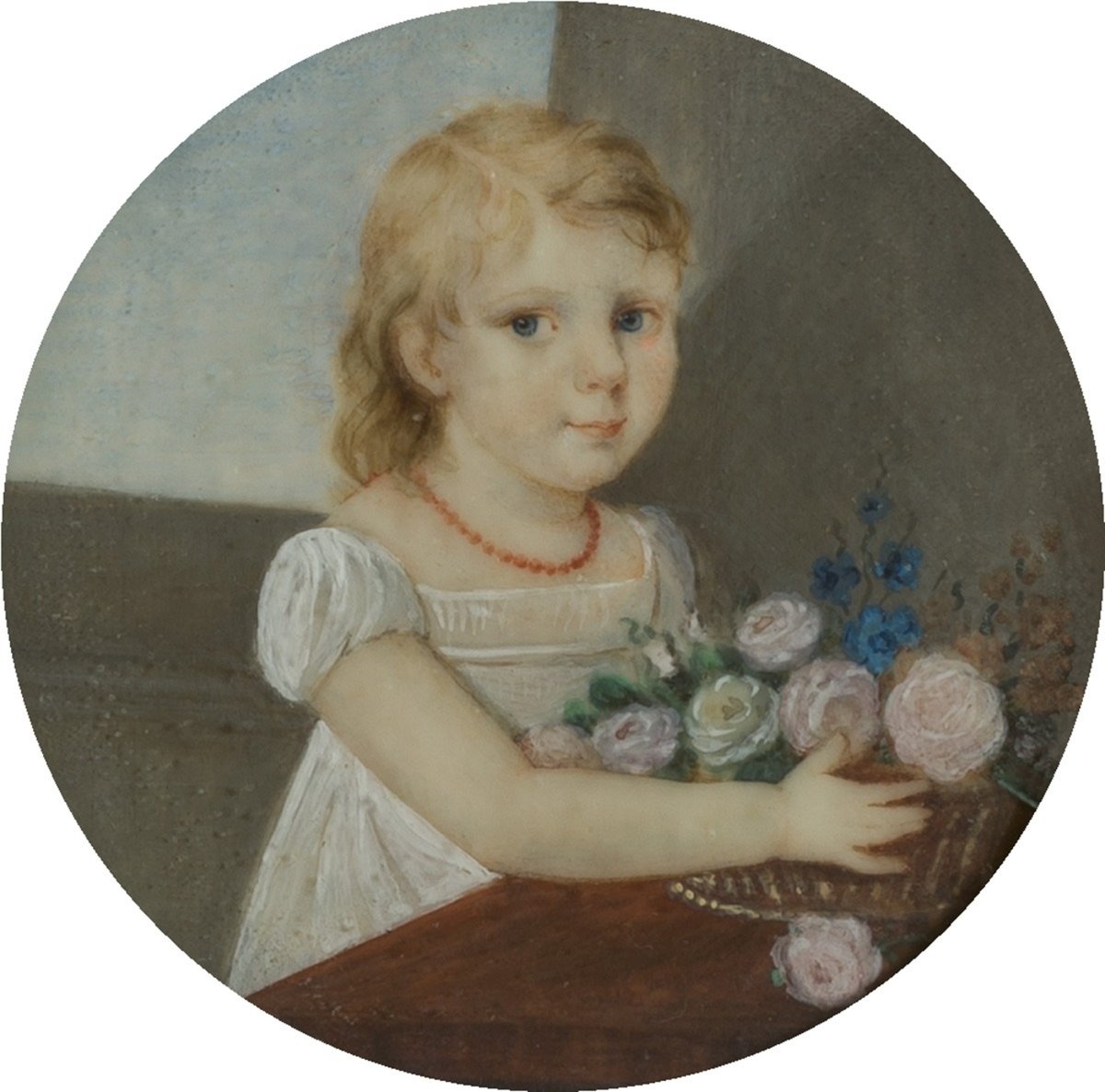
Allegra Byron
(1817–1822)The child of Claire Clairmont and Byron, Allegra was stolen from her mother’s obsession and placed in a convent. Raised in the shadow of her father’s fleeting affection, she died a fragile echo, swallowed whole by the dark void of neglect.
Source: Unknown Artist (floruit 1817–1822), “Allegra, Daughter of Lord Byron (1817–1822),” 1817–1820, enamel miniature on copper, 5.6 × 5.6 cm (2 13/64 × 2 13/64 in.), Gift from Miss Margaret Joyce Brown, OBE, 1990, accession number BORGM 05015, Russell-Cotes Art Gallery & Museum, Bournemouth, Dorset
-
![A black and white portrait of a woman sitting in a relaxed pose, holding a book in her left hand and a string in her right hand. She has curly hair arranged in an updo and is wearing a dark dress with an off-the-shoulder neckline. The background is plain with a subtle shadowed gradient.]()
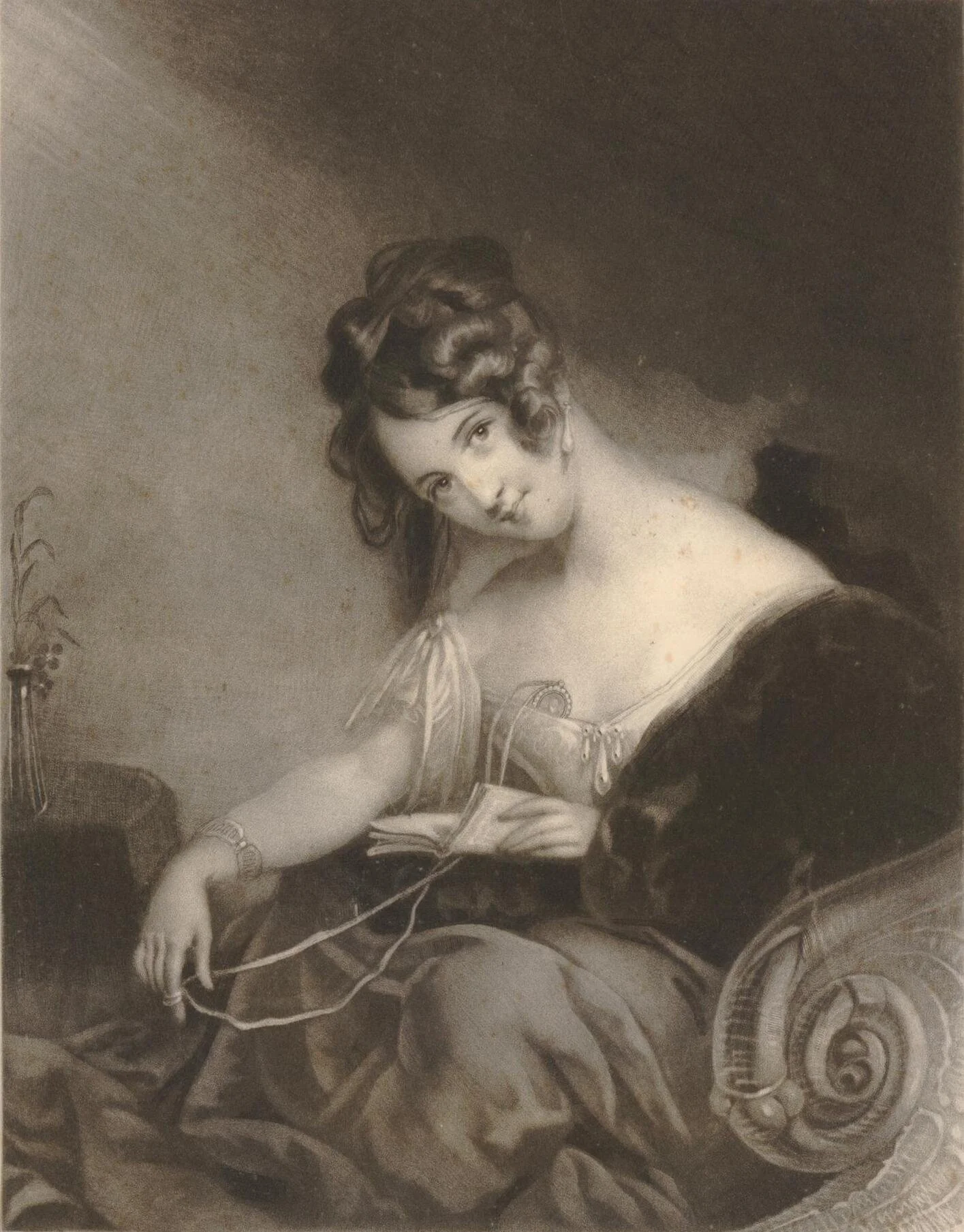
The Forbidden Fruit
Elizabeth Medora Leigh
(1814–1849)Born of incestuous, forbidden love, Medora was the product of Byron’s illicit affair with his half-sister, Augusta. A child tainted by dark desire, she was the very fruit of a poison tree—an heir to a tragic, cursed lineage.
Source: A. M. Huffam (floruit 1825–1859), “The ‘Keepsake’ (Medora Leigh, Alleged Daughter of Lord Byron and His Half-Sister Augusta Leigh),” 1829 (published at London by T. Gillard [floruit 1826–1829] and J[ohn] & F[rederick] Harwood [floruit 1820s–1854] in September 1829), mezzotint with some etching, from a drawing by the engraver, 19.5 × 14.5 cm (7 11/16 × 5 45/64 in.), Collection of letters and documents concerning Byron and Medora Leigh, Acquired by Pierpont Morgan, before 1913, accession number MA 55.39, call number MA 0055, The Morgan Library & Museum, New York (see also the version with a quote from Byron’s Don Juan, Purchased from The Honourable Christopher Lennox-Boyd, 2010, accession number 2010,7081.6352, British Museum, London)
-
![Painting of a woman in 19th-century attire holding a fan or small object, wearing a black lace shawl, with elaborate hairstyle and floral accessories.]()
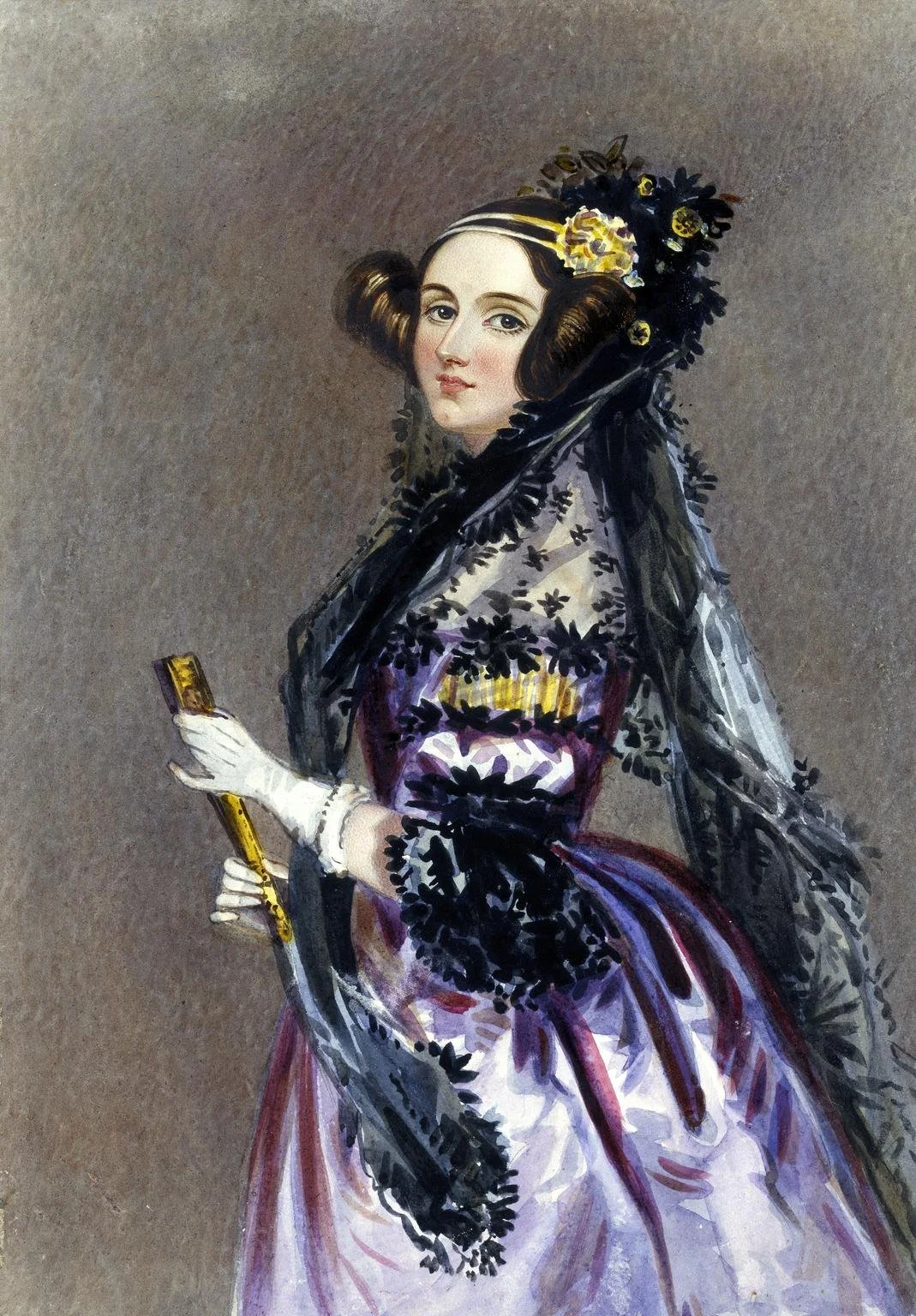
The Analytical Oracle
Ada Lovelace
(1815–1852)Byron’s only legitimate child, Ada was forbidden the allure of her father’s words. Exiled from his world, she became a brilliant mathematician, condemned to reason over passion, a tragic mind locked in an intellectual prison—never to know her father’s touch.
Source: Alfred Edward Chalon (1780–1860), “Portrait of Ada, Countess of Lovelace,” circa 1840, watercolour, 25 × 18.3 cm (9 27/32 × 7 13/64 in.), Science Museum Group Collection, accession number 1995-796, Science Museum, London
-
![Portrait of a man in historical military uniform with medals and decorations, wearing a blue sash, against a neutral background.]()
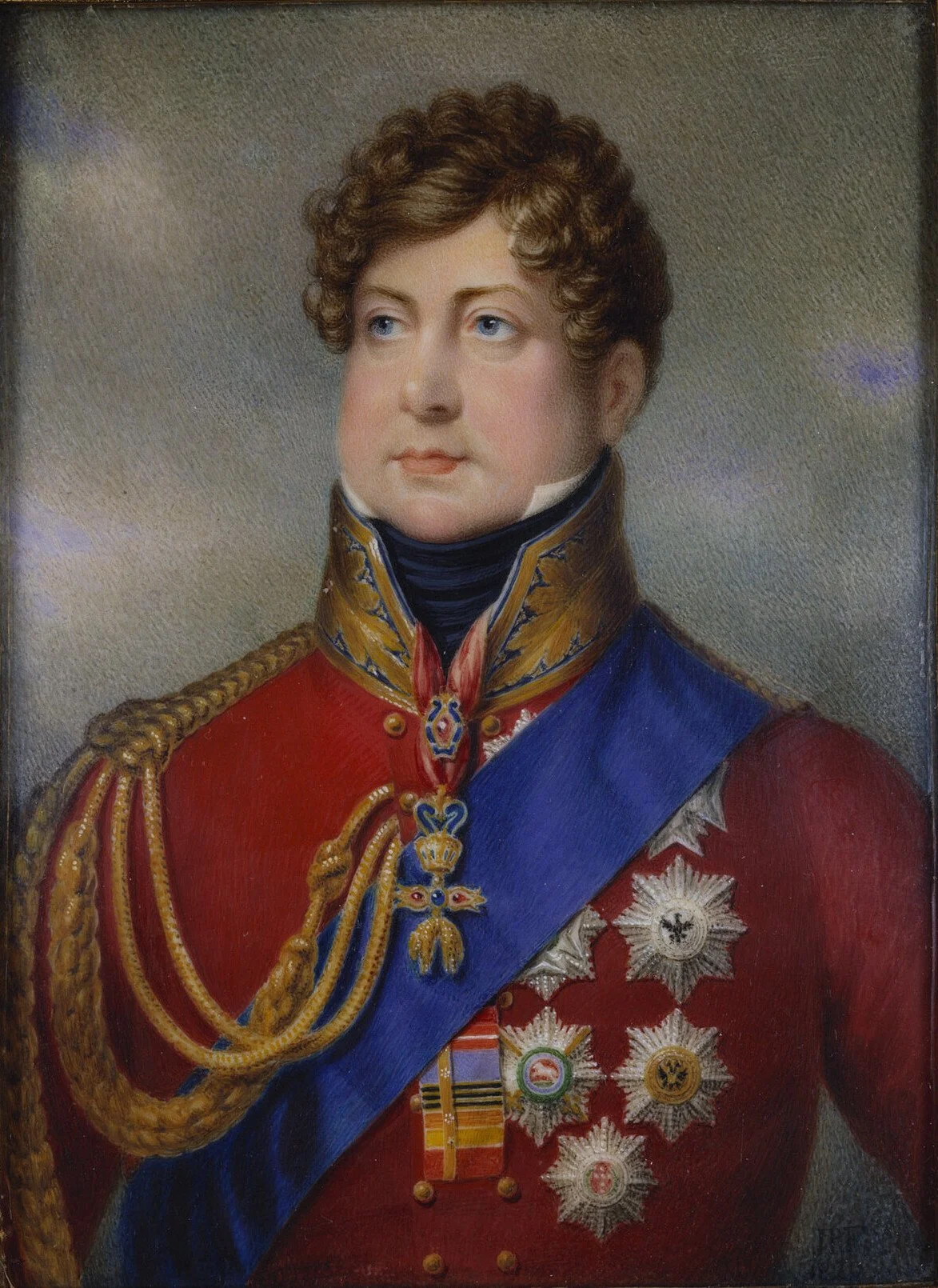
The Self-Conscious Regent
George IV
(1762–1830)George IV, the ridiculed and self-conscious regent, admired Byron’s genius while envying his effortless charisma. Bound by tradition, he could never match Byron’s fiery independence. A distant yet powerful presence, his shadow loomed over the throne he could never claim.
Source: Johann Georg Paul Fischer (1786–1875), “George IV (1762–1820) when Prince Regent,” 1820 (based on Sir Thomas Lawrence’s [1769–1830] full-length portrait of the Prince Regent, painted in 1814, exhibited at the Royal Academy in 1815, and later in the collection of the Marquess of Londonderry), watercolour miniature on ivory laid on card, 11.1 × 8.2 cm (4 ⅜ × 3 15/64 in.), Acquired by Prince Albert at the estate sale of Augustus, Duke of Sussex in 1843, accession number RCIN 420203, Royal Collection Trust, London; Copyright © His Majesty King Charles III
-
![A detailed brown and beige sketch of a man in historical clothing, with a beard, mustache, and a tall hat, holding a rifle and another object.]()
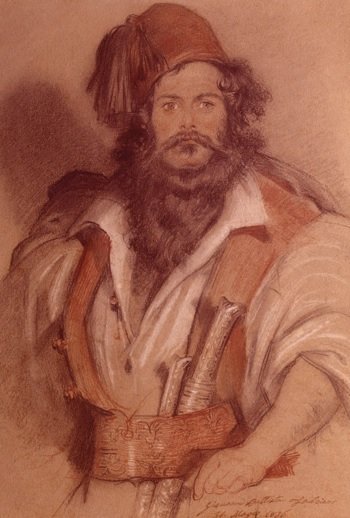
The Loyal Shadow
Giovanni Battista “Tita” Falcieri
(1798–1874)Tita, Byron’s devoted servant, was a constant in his tumultuous world. Through financial ruin and scandal, Tita remained at his side. Their bond, deep and intimate, transcended the servant-master dynamic, an echo of loyalty and quiet love until the end.
Source: Daniel Maclise (1806–1870), “Giovanni Battista Falcieri (Tita) (1798–1874),” May 31, 1836, chalk on paper, 56 × 69 cm (22 3/64 × 27 ⅛ in.), Gift to the National Trust with Hughenden Manor by the Disraelian Society, 1947, accession number 428461, Hughenden Manor, The Disraeli Collection (National Trust), High Wycombe, Buckinghamshire
-
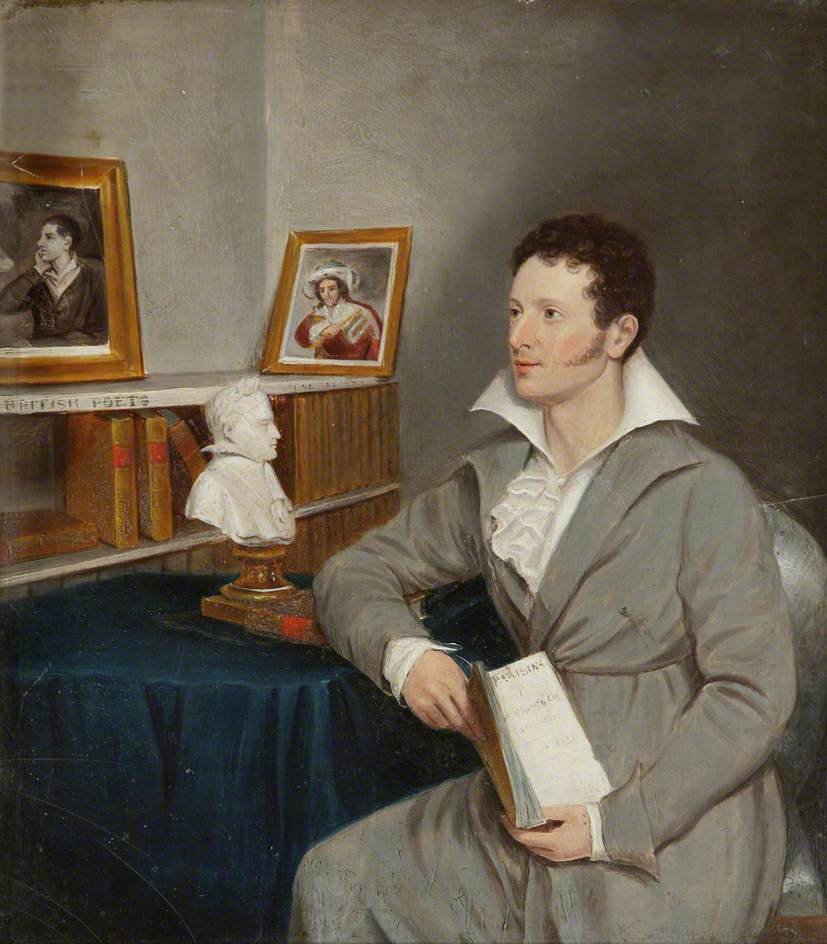
![A young man with dark curly hair and sideburns, dressed in early 19th-century attire, sitting in a room with a book in his hand, surrounded by framed portraits and a bust on a shelf.]()
The Financial Alchemist
Douglas Kinnaird
(1788–1830)Kinnaird, Byron’s financial manager, was the reluctant alchemist of his wealth. Navigating reckless spending and the collision of art and commerce, he tried to turn Byron’s genius into fortune. His loyalty endured, though often consumed by Byron’s excess.
Source: John Raphael Smith (1751–1812), “The Honourable Douglas James William Kinnaird (1788–1830),” circa 1812, oil on panel, 26.5 × 24.5 cm (10 7/16 × 9 21/32 in.), Presented to Mrs J. Griffiths by the sitter, 1822, accession number BCTC01, Bishop’s Castle Town Hall, Bishop’s Castle, Shropshire
-
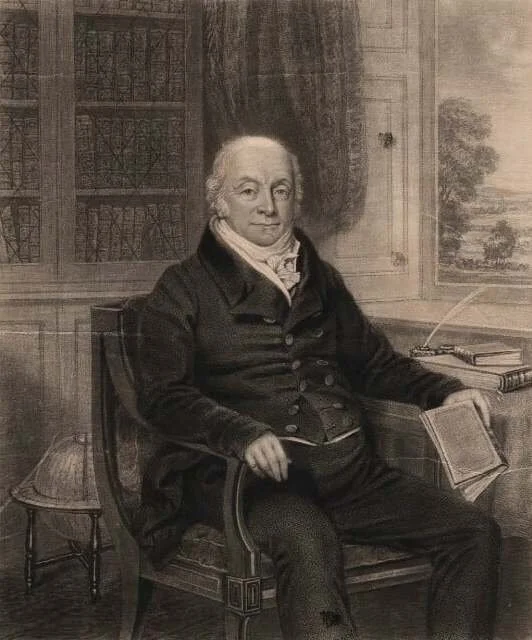
![A black and white painting of a man sitting in a chair in a study, with bookshelves and a window in the background.]()
The Legal Sentinel
John Hanson
(1755–1841)Byron’s steadfast attorney, Hanson guarded his reputation and finances through constant legal turmoil. Calm and measured, he faced the storm of Byron’s chaos, striving to protect the poet’s legacy while caught in the undercurrent of his drama.
Source: Benjamin De La Cour (1795–1843), “John Hanson,” 1820s–1830s (engraved as a mezzotint by John Charles Bromley [1795–1839] in the 1820s–1830s), watercolour miniature on ivory, 30.5 × 25.5 cm (12 × 10 3/64 in.), Purchased with help from the Friends of the National Libraries and the Pilgrim Trust, 1966, Reference Collection, accession number NPG D3222, National Portrait Gallery, London
-
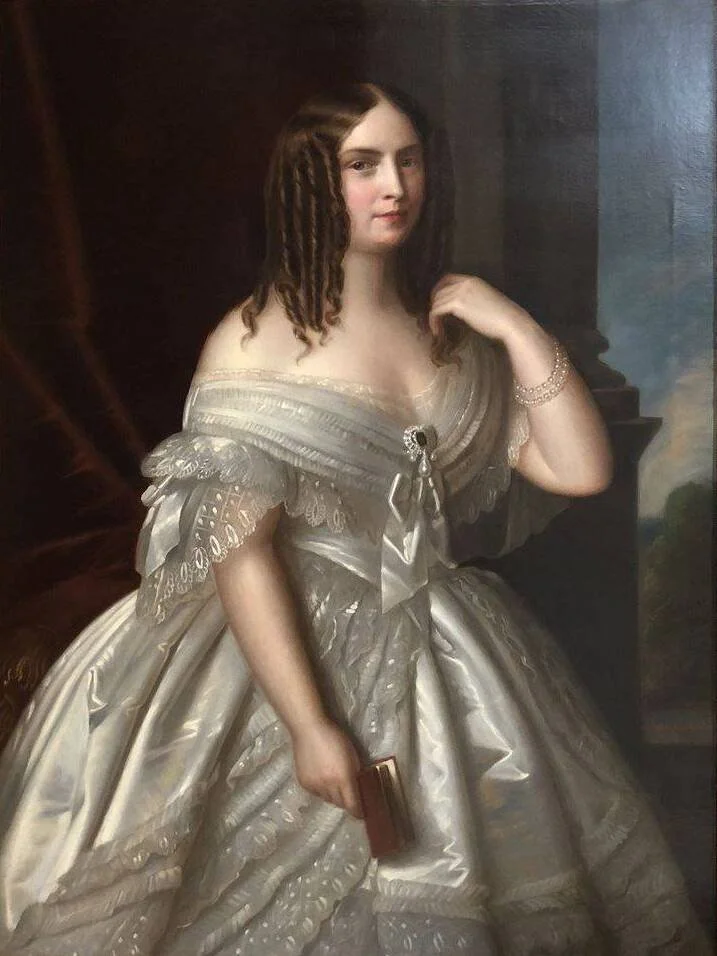
![A young woman with brown hair in an elegant, historic dress standing indoors, holding a small purse in her right hand, wearing a pearl bracelet, with a neutral expression.]()
The Moonlit Sorceress
Teresa, Contessa Guiccioli
(1800–1873)Byron’s final love affair ignited in the shadow of the Italian countryside, where Teresa’s beauty and spirit entranced him. A noblewoman of Ravenna, she became his muse during his last years, their romance infused with passion, longing, and ultimate heartache.
Source: Giuseppe Fagnani (1819–1873), “Portrait of Teresa Gamba Guiccioli,” 1859, oil on canvas, 110.5 × 83.8 cm (43 ½ × 33 in.), Acquired from the Collection of Count Carlo Gamba, 1949, On long-term loan to the Museo Byron (Byron Museum), Musei Byron e Risorgimento (Byron and Risorgimento Museums), Palazzo Guiccioli (Guiccioli Palace), Ravennna, accession number unknown, Private Collection
-
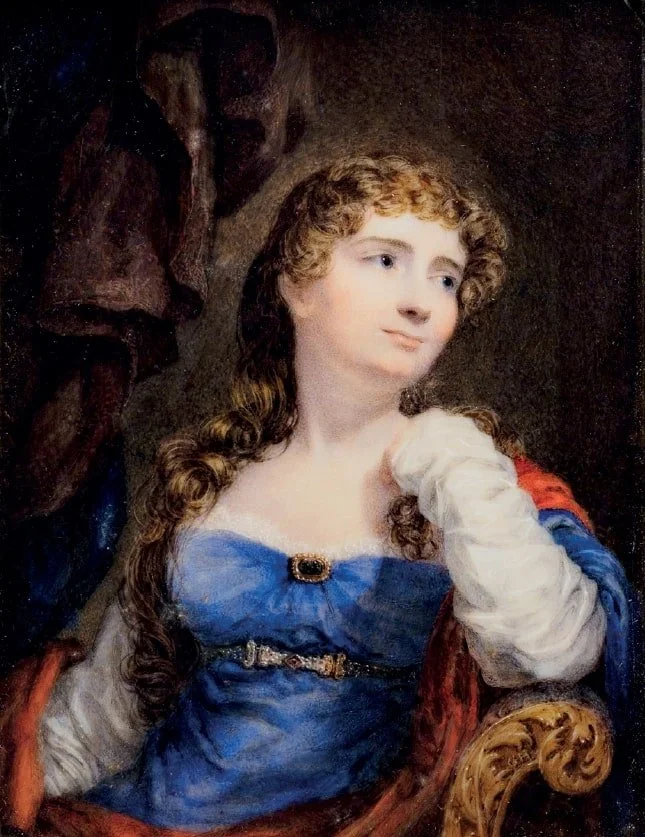
![A young woman with long, curly brown hair in historical clothing, sitting in a decorated chair with a contemplative expression, with a dark background.]()
The Rational Beauty
Lady Byron
(1792–1860)Annabella Milbanke, poised and enigmatic, stood as a calm counterpoint to the tempest of her era. A woman of intellect and restraint, she sought reason amidst the chaos of Byron’s world, her mind a fortress of sharp clarity against a sea of romantic tumult.
Source: Charles Hayter (1761–1835), “Portrait of Annabella Byron (née Anne Isabella Milbanke) (1792–1860),” 1812, watercolour miniature on ivory, 11.4 × 8.79 cm (4 31/64 × 3 29/64 in.), Collection of the Earl of Lytton, accession number unknown, Knebworth House Archive, Estate Office, Knebworth House, Knebworth, Hertfordshire
-
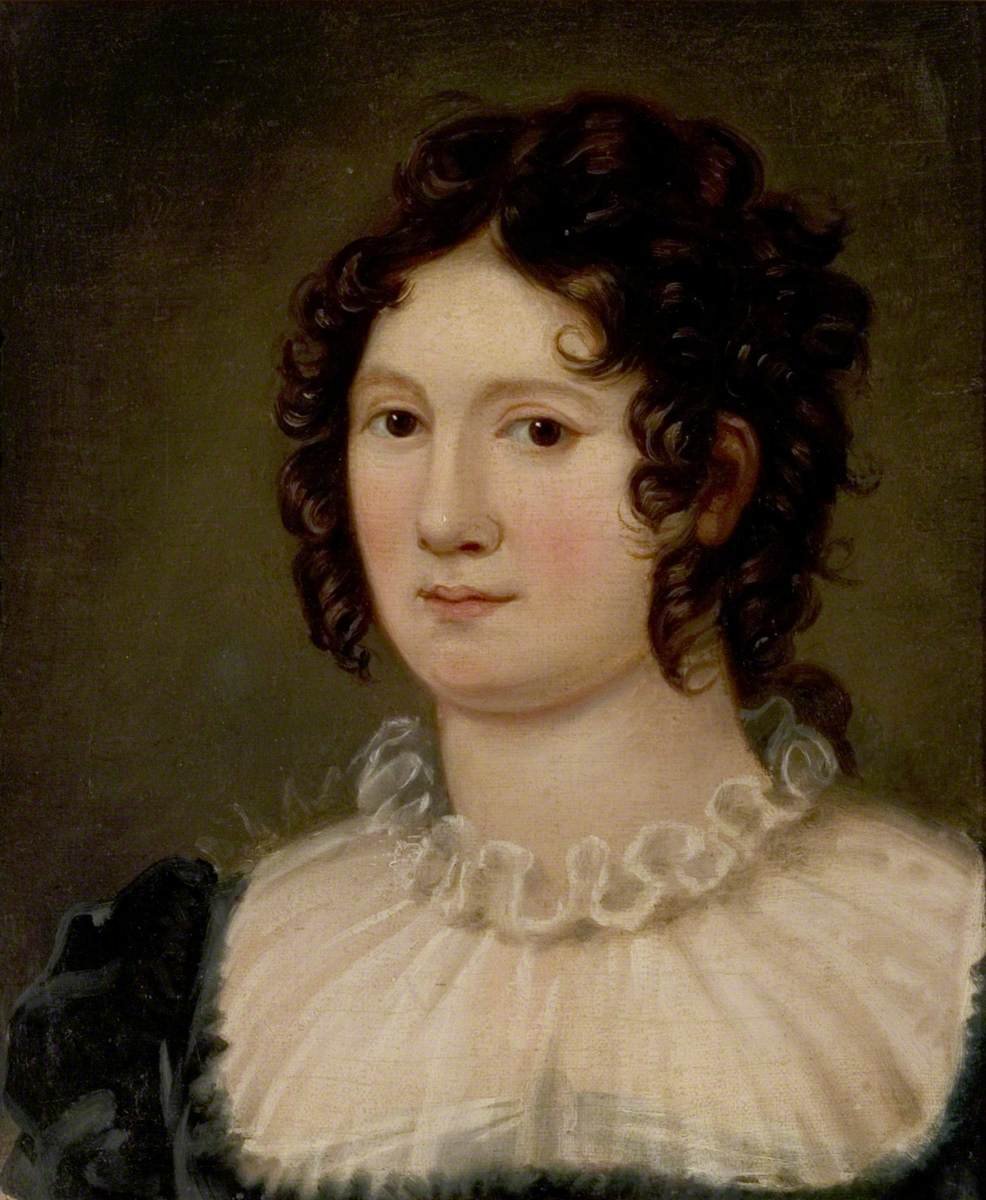
![Portrait of a woman with curly dark hair, wearing a white ruffled collar and dark dress, against a dark background.]()
The Enigmatic Muse
Claire Clairmont
(1798–1879)Clara Clairmont, a flame flickering in the shadows, danced between love and madness. Her life, tangled in passion and intrigue, entwined with poets and ghosts alike. In her silence, she echoed the dark reveries of those who shaped the Romantic world.
Source: Amelia Curran (1775–1847), “Claire Clairmont (1798–1879),” 1819, oil on canvas, 47 × 35 cm (18 ½ × 13 25/32 in.), Gift from Lieutenant-Colonel K. Edgcumbe, 1938, accession number NA 271, Newstead Abbey, Nottingham City Museums & Galleries, Nottingham City Council, Ravenshead, Nottinghamshire
-
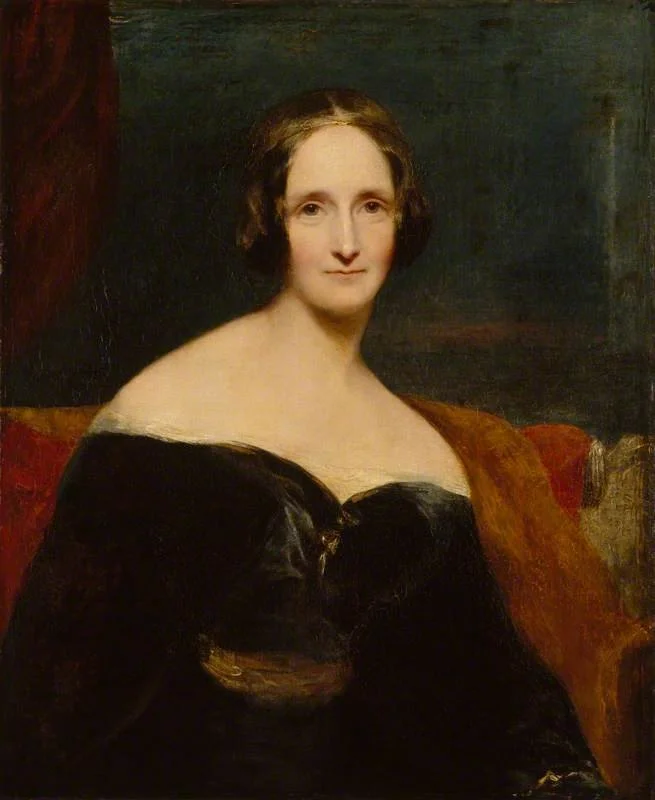
![A classical portrait painting of a woman with short brown hair, wearing a black dress with an off-the-shoulder neckline, seated on a red and brown armchair with a dark background.]()
The Gothic Enchantress
Mary Shelley
(1797–1851)Mary Shelley, the creator of worlds, wove nightmares into the fabric of reality. Her pen birthed monsters and mysteries, her mind a labyrinth of shadowed truths. With dark grace, she gave voice to the unspoken horrors that lurk beneath the surface of existence.
Source: Richard Rothwell (1800–1868), “Mary Wollstonecraft Shelley,” circa 1831–1840, 73.7 × 61 cm (29 1/32 × 24 1/32 in.), Bequeathed by the sitter’s daughter-in-law, Jane, Lady Shelley, 1899, On long-term loan to Dove Cottage & Wordsworth Museum, Cumbria, Primary Collection, accession number 1235, National Portrait Gallery, London
-
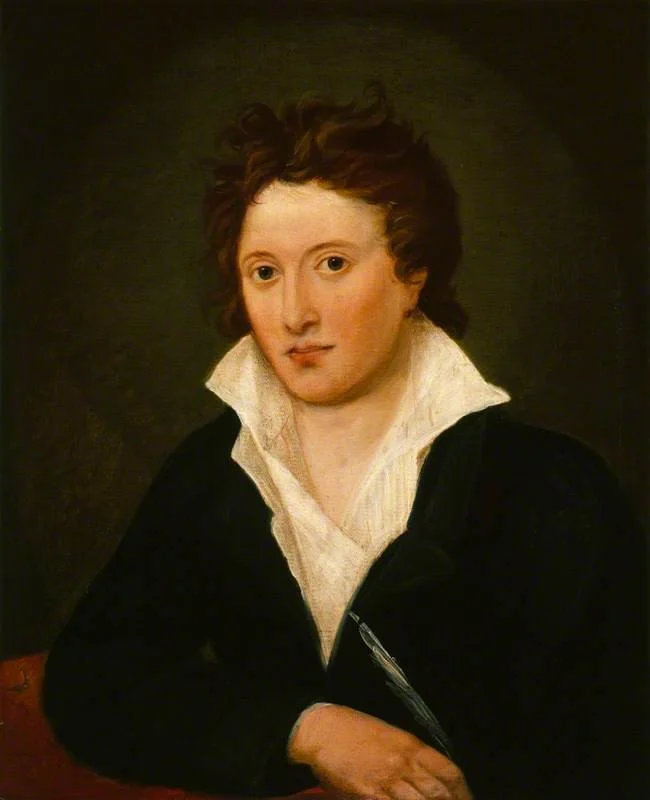
![Portrait of a young man with curly brown hair, wearing a white shirt with a high collar and a black jacket, seated against a dark background.]()
The Tempestuous Visionary
Percy Bysshe Shelley
(1792–1822)Percy Bysshe Shelley, the radical poet, sculpted verses from chaos and flame. A soul adrift in an eternal storm, he defied convention, embracing nature’s dark beauty and the occult’s whispered truths. His words, like fire, burned through the shadows of his time.
Source: Amelia Curran (1775–1847), “Percy Bysshe Shelley,” 1819, oil on canvas, 59.7 × 47.6 cm (23 ½ × 18 ¾ in.), Bequeathed by the sitter’s daughter-in-law, Jane, Lady Shelley, 1899, On long-term loan to Dove Cottage & Wordsworth Museum, Cumbria, Primary Collection, accession number 1234, National Portrait Gallery, London
-
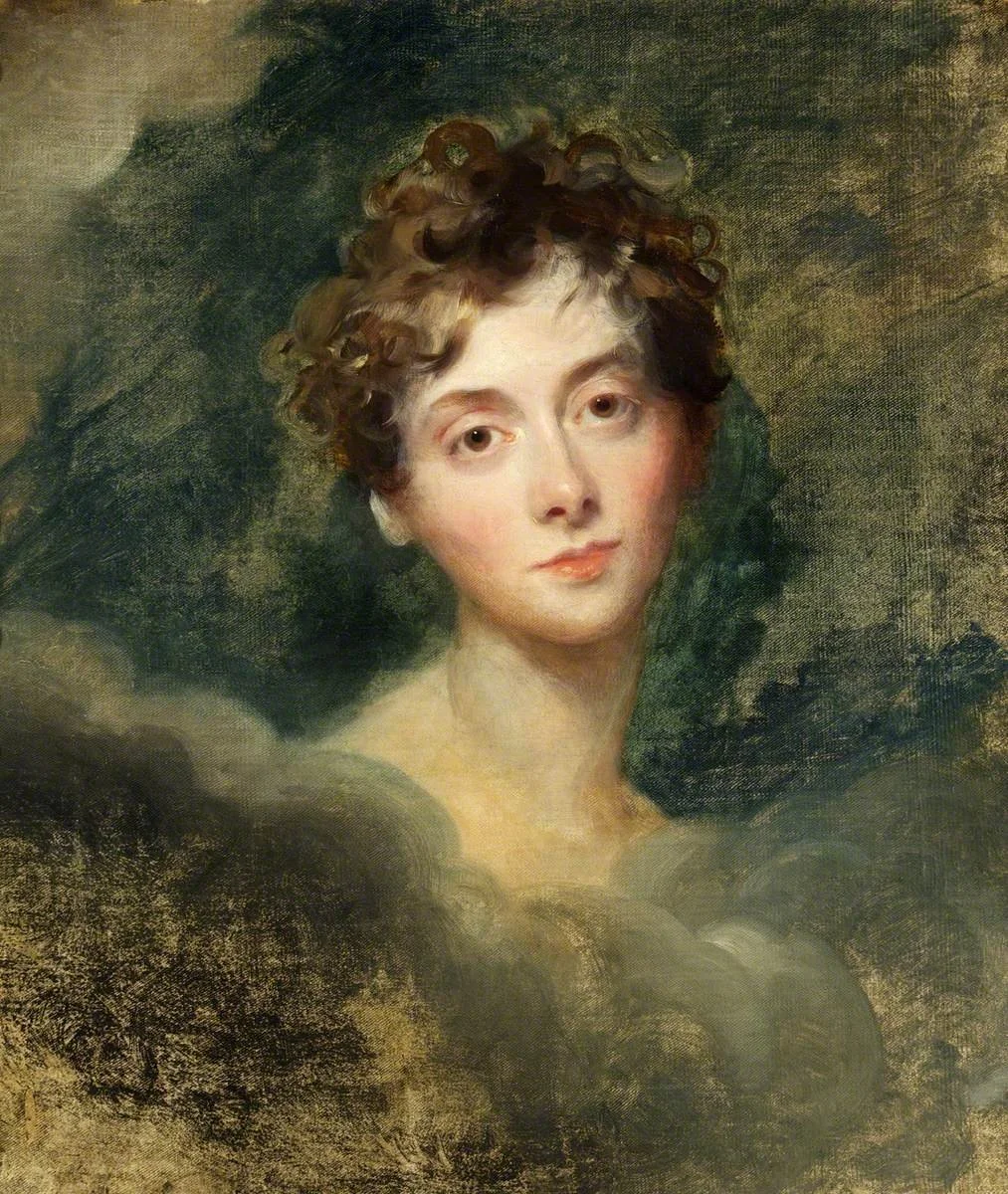
![A classical portrait painting of a woman with curly hair, gazing softly at the viewer, surrounded by dark greens and muted tones.]()
The Infatuated Aristocrat
Lady Caroline Lamb
(1785–1828)“Mad, bad, and dangerous to know,” she wrote the night they met. From that moment, her infatuation smouldered, growing into a maddening inferno—unrelenting, obsessive, and destructive. Her scandalous passion caricatured and immortalized Byron as the “Bad Lord” in Glenarvon.
Source: Thomas Lawrence (1769–1830), “Lady Caroline Lamb (d. 1828),” circa 1827, oil on canvas, 55 × 47.2 cm (21 21/32 × 18 37/64 in.), Gift from George F. de Menasce through the Art Fund in memory of Baron Charles de Menasce of Alexandria, Egypt, 1948, accession number K2141, Bristol Museum & Art Gallery, Bristol
-
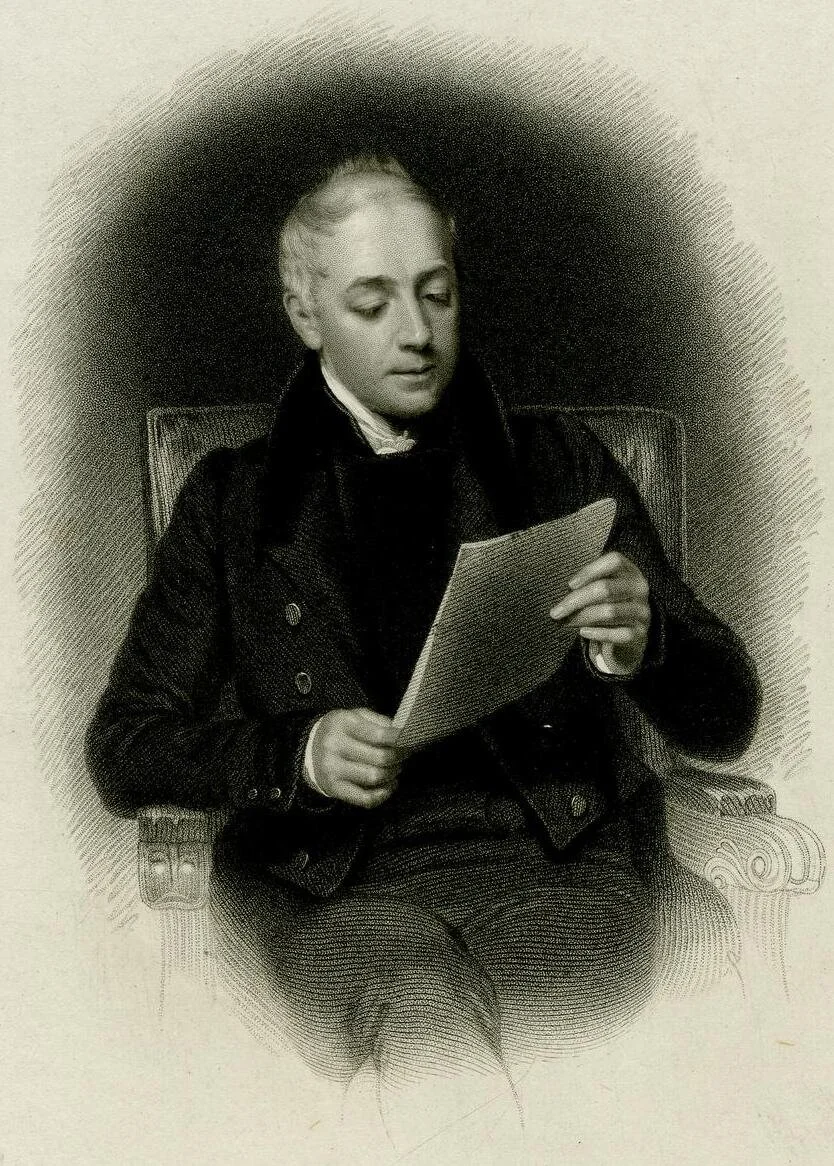
![A black-and-white illustration of a man with light-colored hair, seated on a chair, reading a document. He is wearing period clothing, including a dark coat and striped trousers, with a serious expression.]()
The Patient Publisher
John Murray
(1778–1843)More than Byron’s publisher, John Murray was the quiet architect of his fame and fortune. A patient confidant, he shaped both poet and myth, bridging Byron’s private madness with his public legacy, crafting a narrative that would endure.
Source: Henry William Pickersgill (1782–1875), “Mr. Murray, Publisher of Lord Byron’s Works (Illustration to Finden’s Illustrations of the Life and Works of Lord Byron: Vol. II) (Proof Before Letters),” circa 1833 (stipple-engraved on chine collé by Edward Finden [1791–1857] and published at London by John Murray [1778–1843] in 1833), oil on canvas, 13 × 9 cm (5 ⅛ × 3 35/64 in.), Donated by George Smith, the printseller, 1876, accession number 1876,1209.596, British Museum, London
-
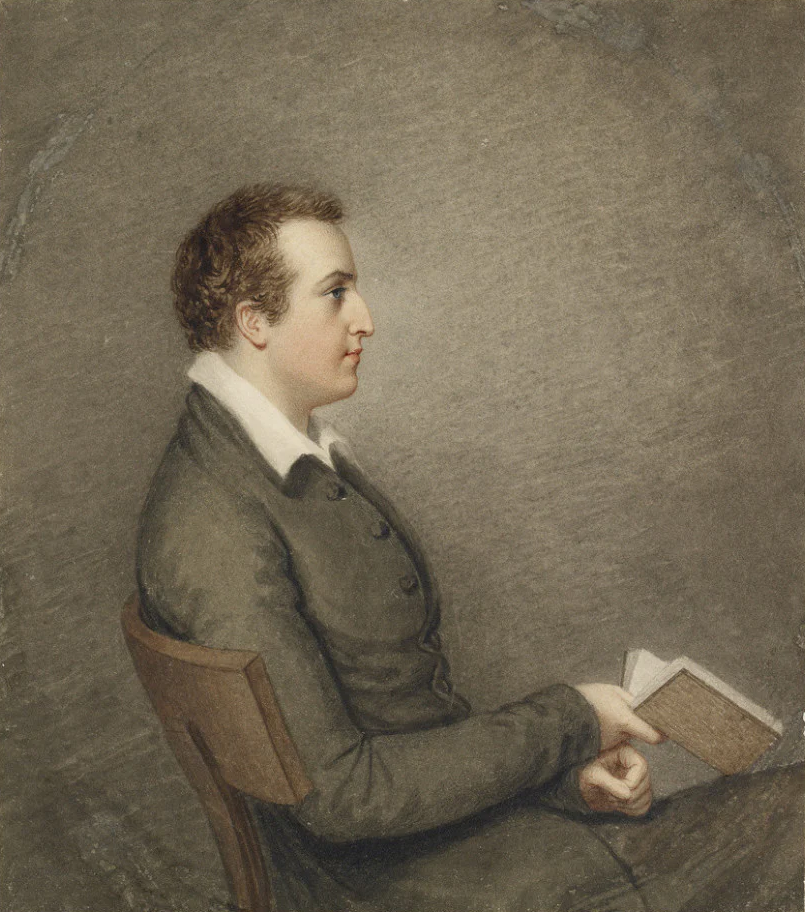
![A realistic painting of a young man with short, curly hair, wearing a gray blazer and white shirt, sitting on a wooden chair, holding an open book in his left hand, and looking to the left against a plain, muted background.]()
The Loyal Friend
John Cam Hobhouse
(1786–1869)Amidst Byron’s chaos, Hobhouse stood unwavering—a silent anchor to the poet’s brilliance. His quiet intensity grounded Byron’s wildness, his loyalty a secret pulse behind the genius, steadfast through exile, politics, and the storm of madness.
Source: Adam Buck (1759–1834), “Portrait of John Cam Hobhouse, 1st Baron Broughton,” 1818, watercolour on paper, 20.6 × 18.1cm (8 7/64 × 7 ⅛ in.), Purchased with the assistance of the Hope Collection Fund, 1956, accession number WA1956.6, Ashmolean Museum, Gardens, Libraries, and Museums, Chancellor, Masters, and Scholars of the University of Oxford, Oxford
-
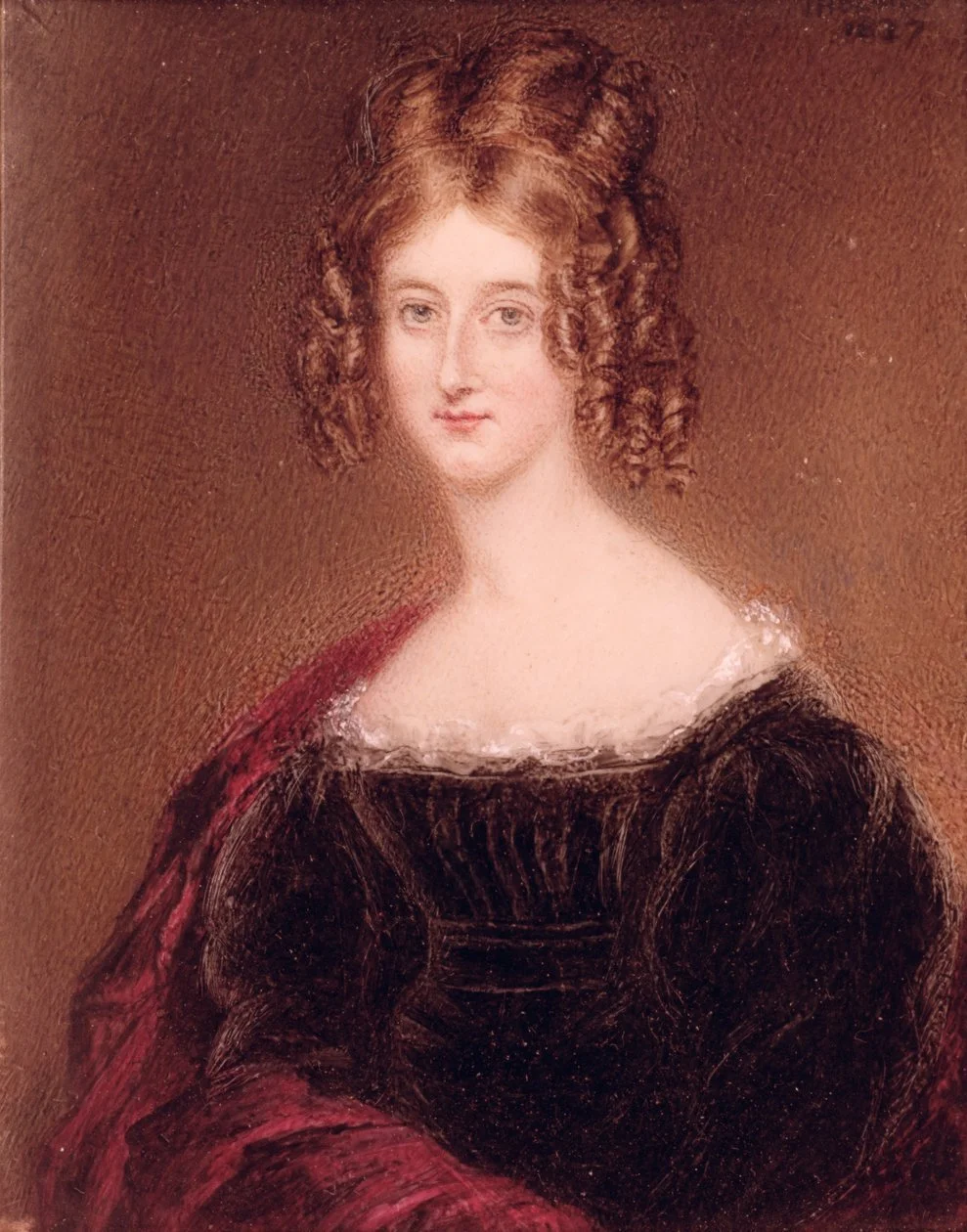
![A portrait of a woman with curly, reddish hair, wearing a dark dress with a red shawl draped over her shoulder, set against a brown background.]()
The Scandalous Sister
Augusta Leigh
(1783–1851)Bound by blood and a forbidden love, Augusta was both a muse and a shadow in Byron’s life. Their intimate bond sparked a scandal that would haunt them both, a secret forever entwined in the legacy of his name.
Source: James Holmes (1777–1860), “Augusta Byron (1783–1851), later The Honourable Augusta Leigh,” 1817, watercolour miniature on ivory, 11.4 × 8.95 cm (4 ½ × 3 33/64 in.), Collection of the Earl of Lytton, accession number unknown, Knebworth House Archive, Estate Office, Knebworth House, Knebworth, Hertfordshire
-
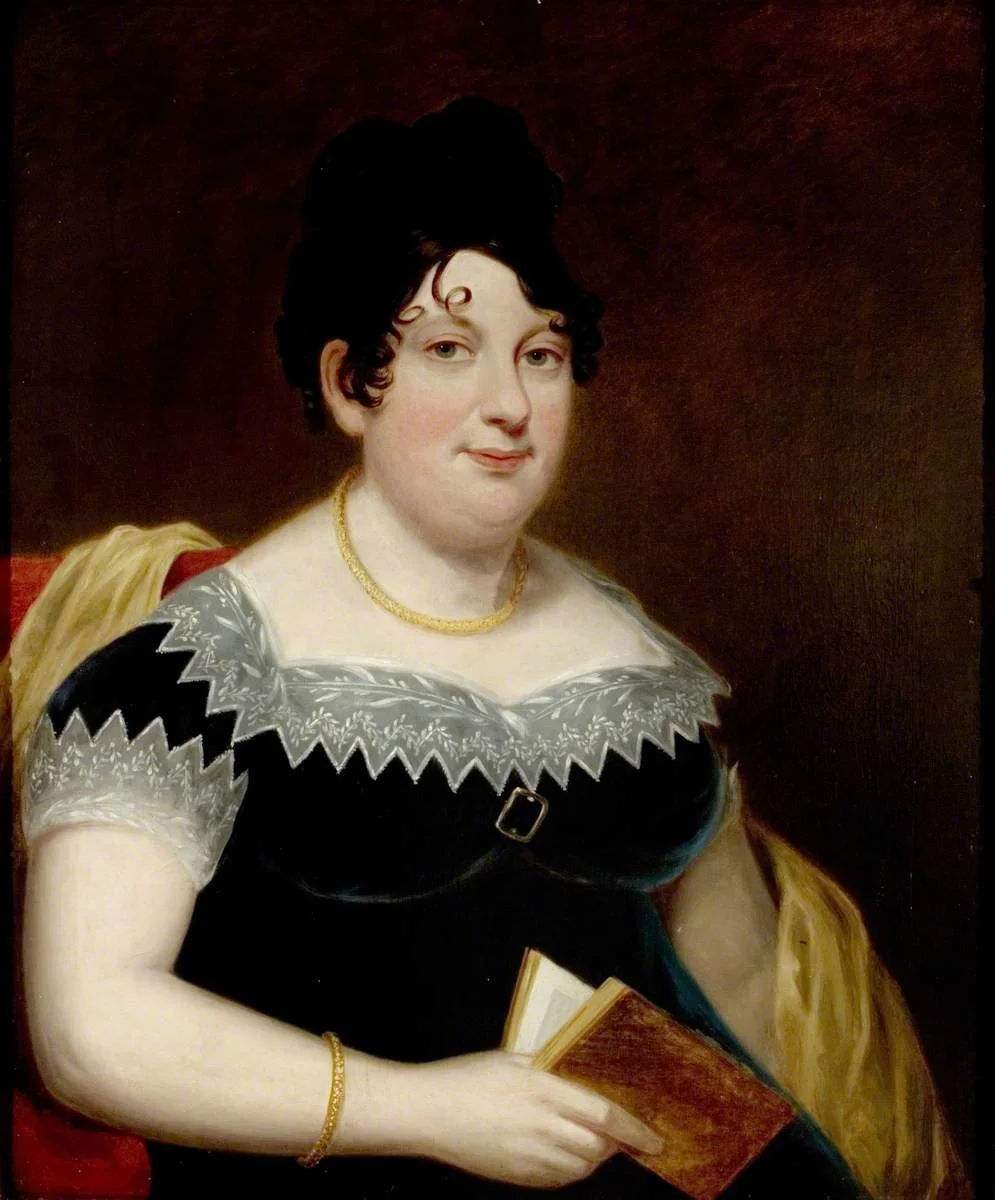
![Portrait of a woman with dark hair, wearing a black dress with white embroidery, holding a book, with a gold necklace and bracelet, seated against a dark background.]()
The Unrelenting Matron
Catherine Gordon Byron
(1765–1811)Fiercely protective yet bitter, Catherine’s love for her son was as unwavering as her hatred for the world that had wronged her. Her presence, both oppressive and constant, would forever shape Byron's sense of self.
Source: Thomas Stewardson (1781–1859), “Mrs Catherine Gordon Byron (1765–1811),” circa 1805, oil on canvas, 73.5 × 65.4 cm (28 15/16 × 25 ¾ in.), On Loan from a Private Collection, 2003, accession number NCMG 2015-66, Newstead Abbey, Nottingham City Museums & Galleries, Nottingham City Council, Ravenshead, Nottinghamshire
-
![A detailed black and white engraving of a young person wearing a historic military uniform with a high-collared shirt and a sash, and a hat with a feather and a decorative element.]()
The Phantom Father
Captain John “Mad Jack” Byron
(1757–1791)An absent figure whose reckless life cast a long, unyielding shadow over his son. Byron’s father, who abandoned him at three, died abroad—whether by suicide or overdose—leaving only a legacy of irresponsibility, self-destruction, and emotional neglect.
Source: N. Shaw (floruit 1780), “Captain John ‘Mad Jack’ Byron (1757–1791),” 1780, engraving, 52.9 × 44 cm (20 53/64 × 17 5/16 in.), Nottingham Local Studies Library Photograph & Image Collection, accession number NTGM009341, Newstead Abbey, Nottingham City Museums & Galleries, Nottingham City Council, Ravenshead, Nottinghamshire
Behind the Scenes.
The Making of Lightning
A glimpse into the storm behind the screen, where magic meets madness.
Step behind the curtain of Lightning in the Veins to witness the craft, the chaos, and the creativity that fuel Byron’s dramatic reawakening. From set design to costume artistry, every frame is forged in passion and mystery. Check back soon for exclusive glimpses into the making of the film that brings Byron’s dark legacy to life.
Testimonials.
Voices from the Storm
Hear from the storm-chasers—creatives, cast, and crew—who brought Byron back to life.
The tale of Byron’s reawakening has been a shared vision—a journey fueled by the creative minds who dared to reimagine his myth. Soon, we’ll share what our collaborators have to say about breathing life into this cinematic storm. Check back for stories from the actors, crew, and artists who have poured their passion into Lightning in the Veins.
Call to Action.
Join the Storm
Invest, collaborate, or follow us into the heart of darkness.
Byron’s tale is one of bold risks and immortal legends. Now, you have the chance to be part of his cinematic reawakening. Whether you’re an investor, a collaborator, or a fan, you have a role to play in this storm. Get in touch today to find out how you can help bring Byron’s myth back to life.
Press & Media Coverage